The Pandemic : Digital Humanity
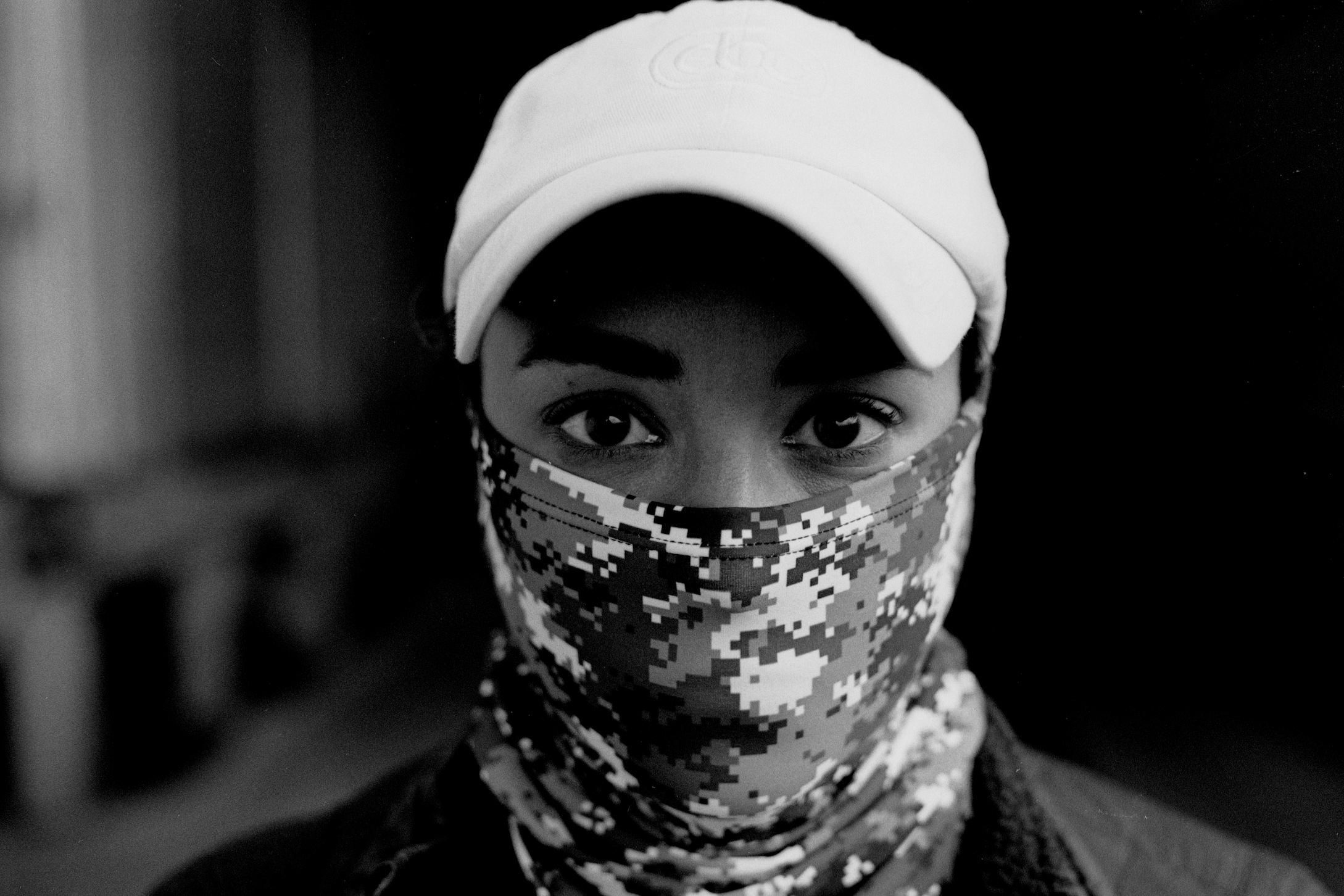
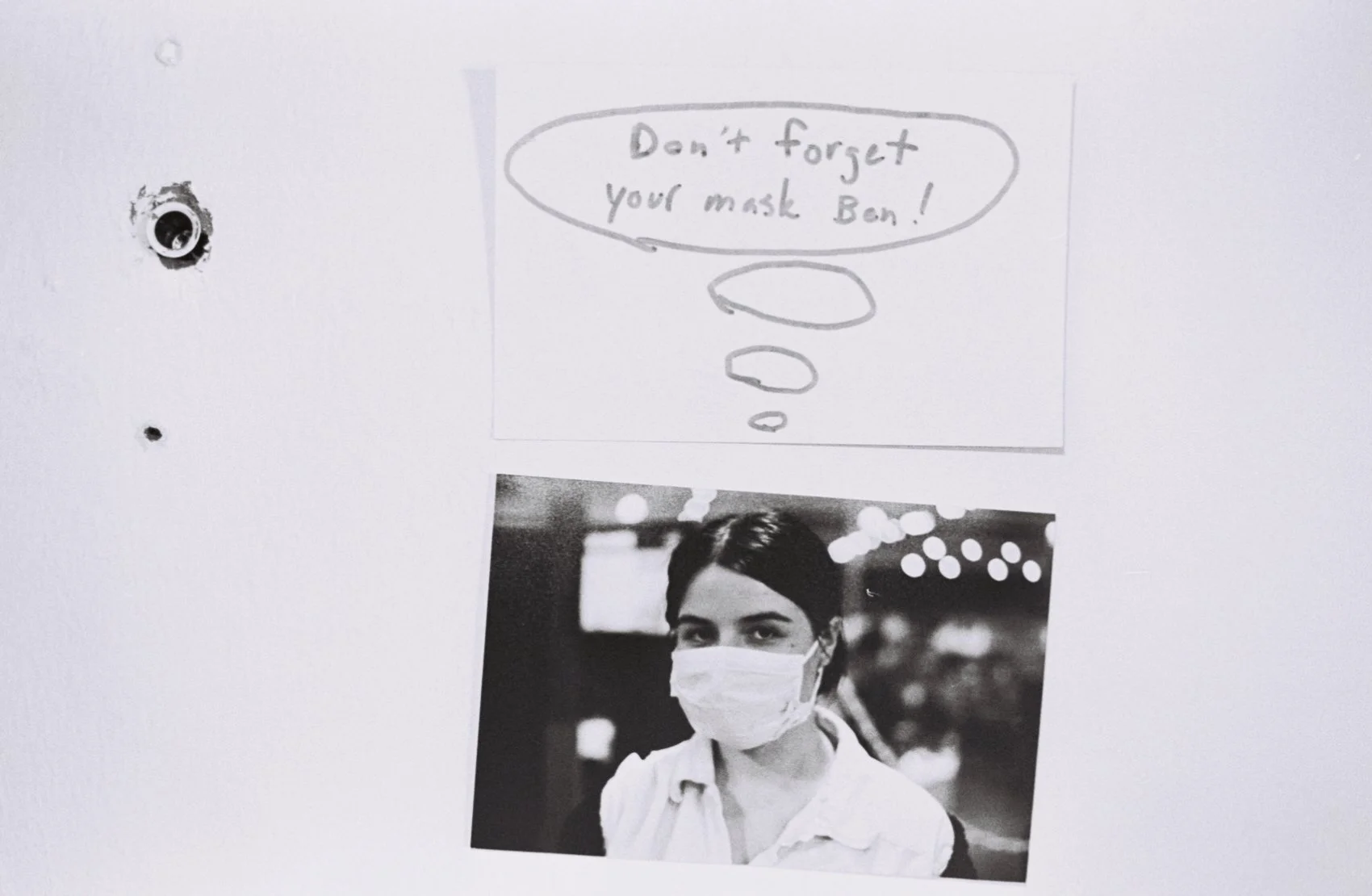
A young woman faces the camera, her mouth covered by a pixelated mask that resembles digital code.
Masks, social distancing, haircuts at home, remote work, telemedicine. A new vocabulary emerged as proximity became risk. The pandemic did not only separate bodies; it reframed humanity itself, compressing touch into signal and presence into image, quietly redefining what it meant to be human in the modern world.
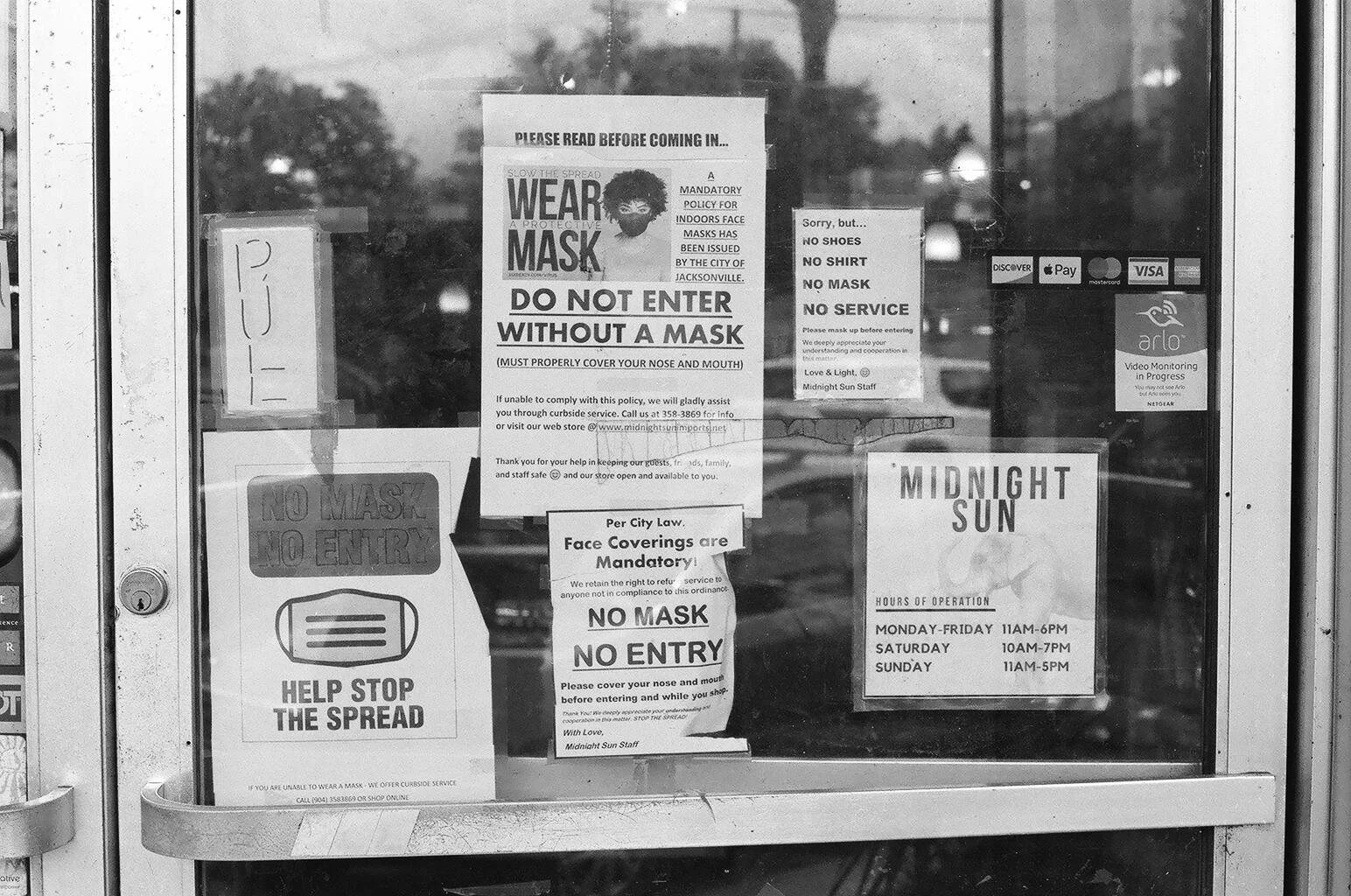
A storefront window is covered with overlapping notices about masks, transforming glass into a wall of instruction.
The mask became the defining symbol of the pandemic. A small piece of fabric carrying disproportionate weight. It signaled safety, compliance, resistance, fear, responsibility, division. More than a health measure, it became identity. In this image, the repetition of mandates reflects how the symbol moved from recommendation to requirement, from personal choice to public threshold.
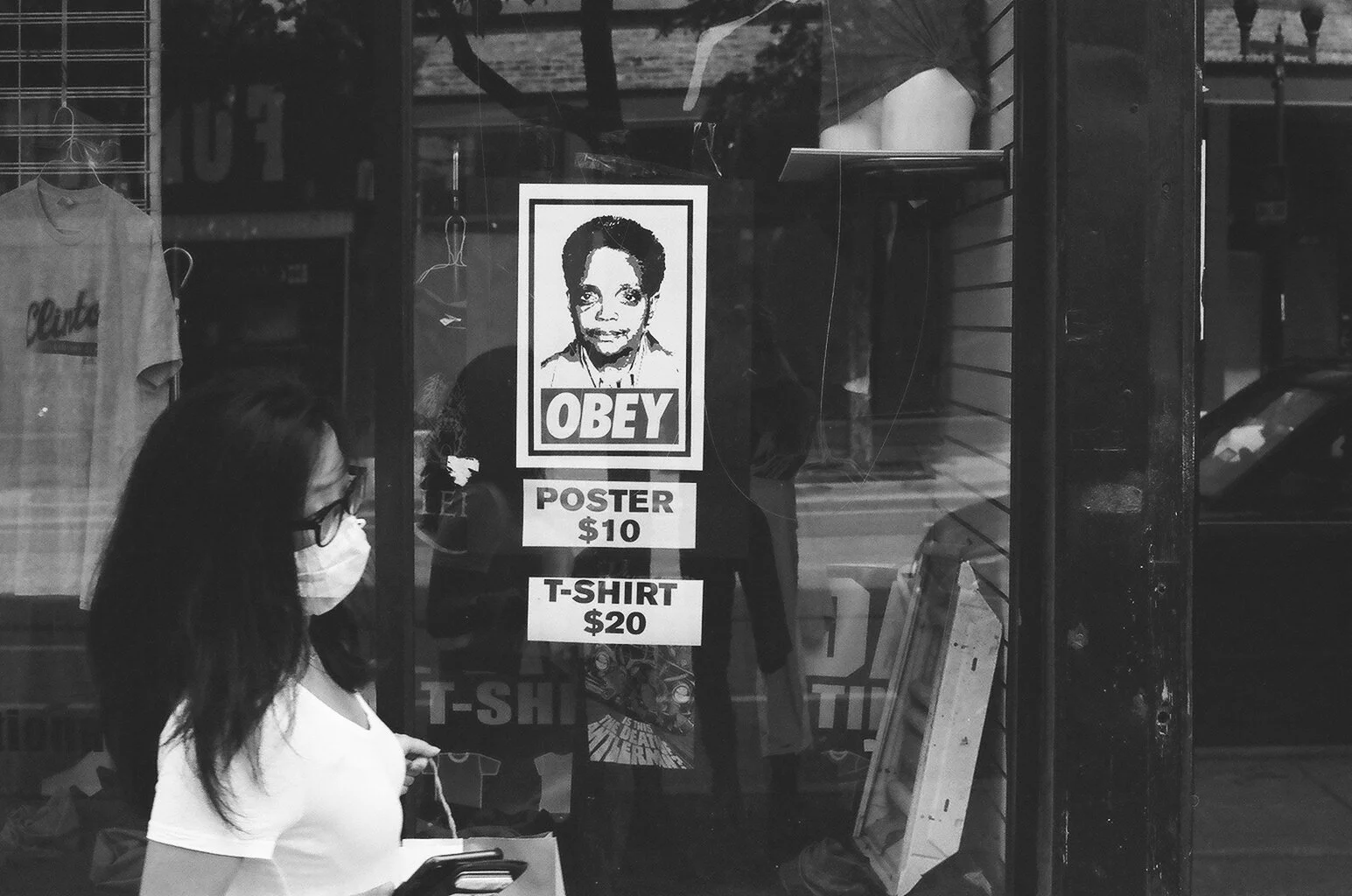
A masked woman stands outside a storefront window displaying a pop art “OBEY” poster featuring Chicago mayor Laurie Lightfoot, offered for sale alongside T shirts.
The image layers irony over reality. What began as a street art slogan becomes a literal command in the middle of a public health crisis, blurring satire and instruction. It reflects how the pandemic moved beyond medicine into culture, politics, and commerce, turning obedience itself into symbol, product, and debate.
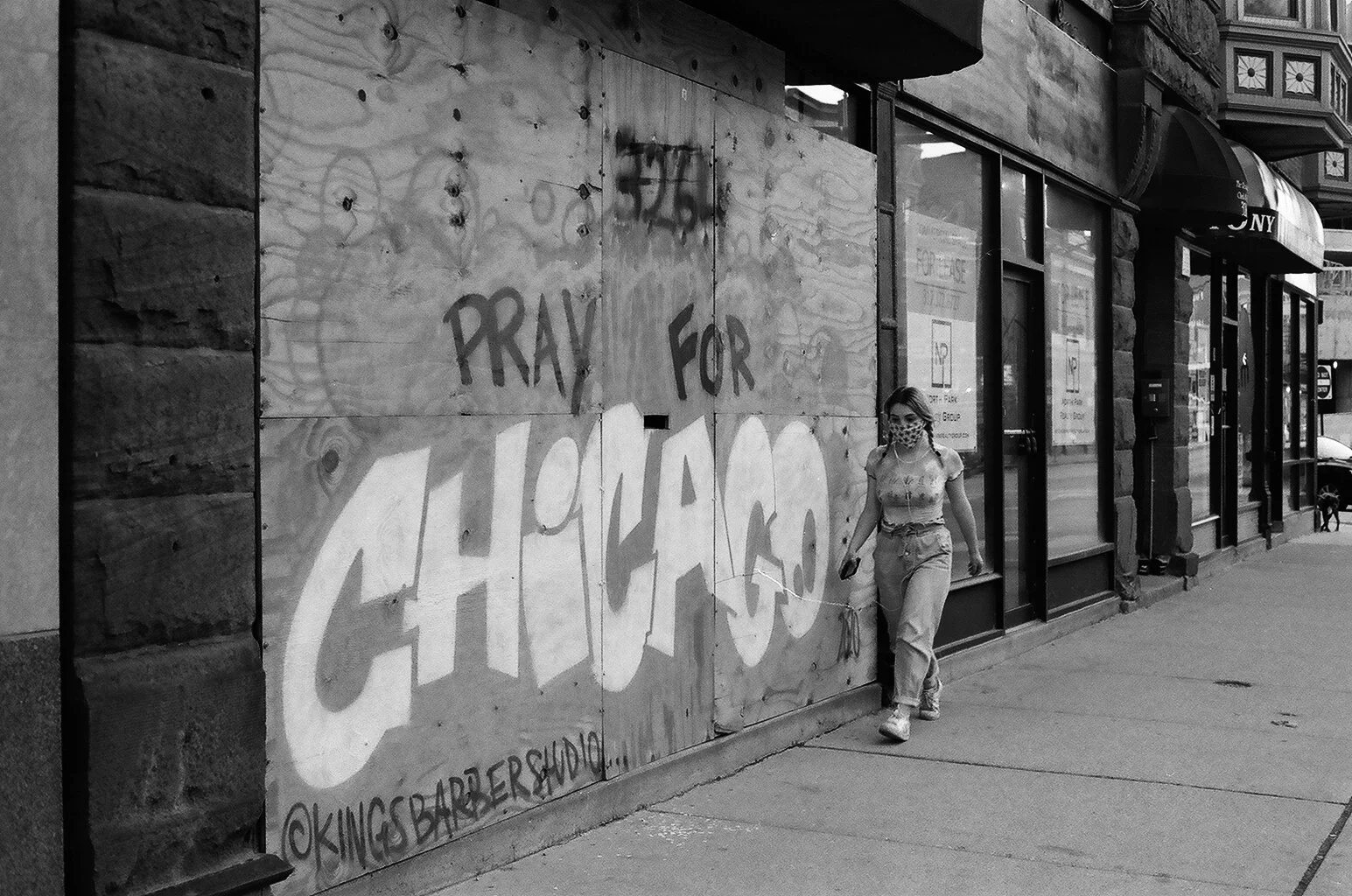
A boarded storefront in Chicago is covered in plywood and spray-painted with the words “Pray for Chicago” as a masked woman walks past.
The boarded windows signal economic shutdown and urban silence, while the graffiti reads like both plea and protest. This image captures the despair beneath the directives, the moment when isolation moved beyond inconvenience and into collective anxiety, when cities felt paused and uncertain about what would return.
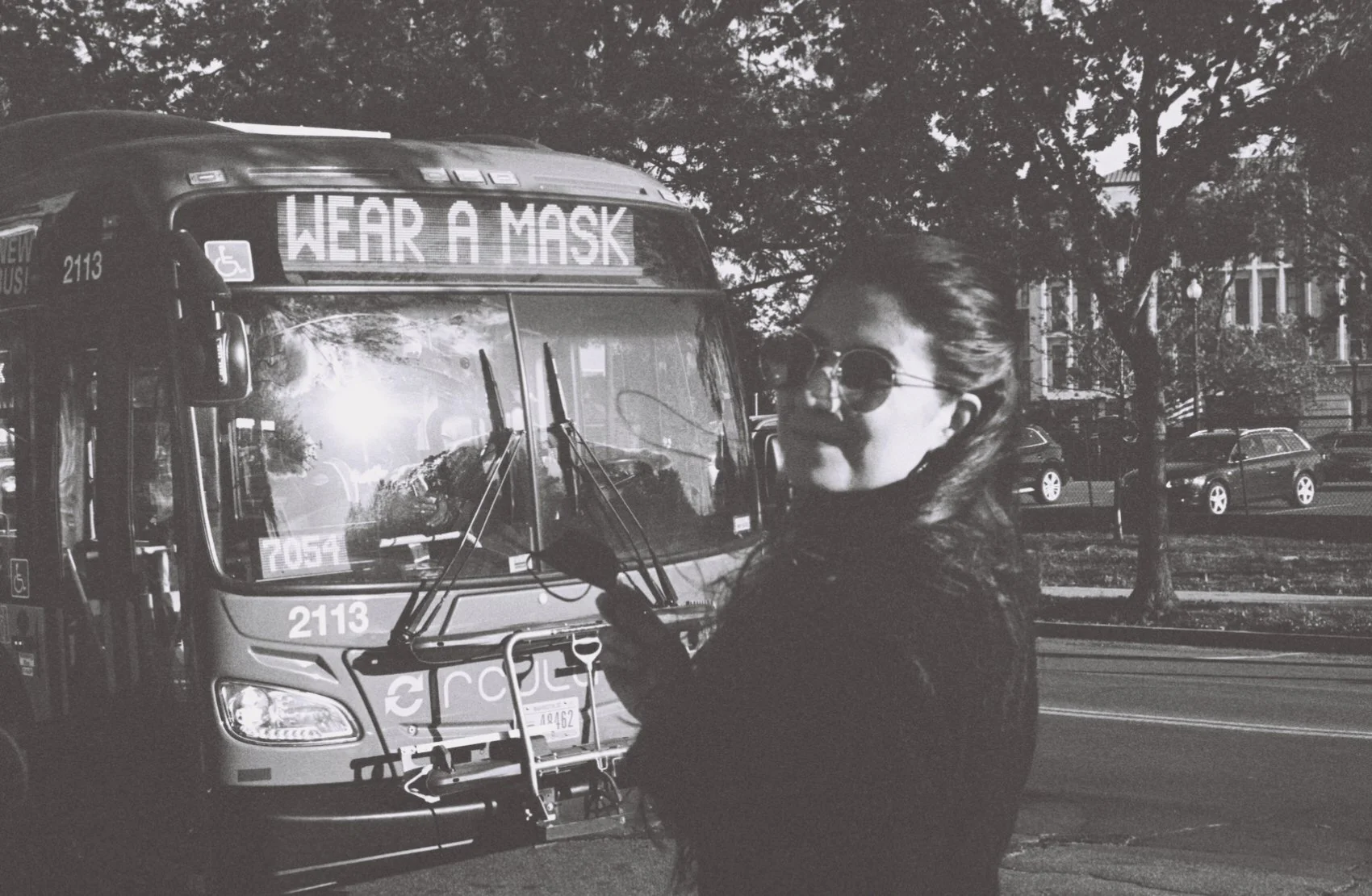
A Washington DC metro bus flashes “WEAR A MASK” while a young woman stands in front of it, her face uncovered.
The directive glows above her like law. This frame captures the tension of the pandemic; public command and private choice occupying the same space.
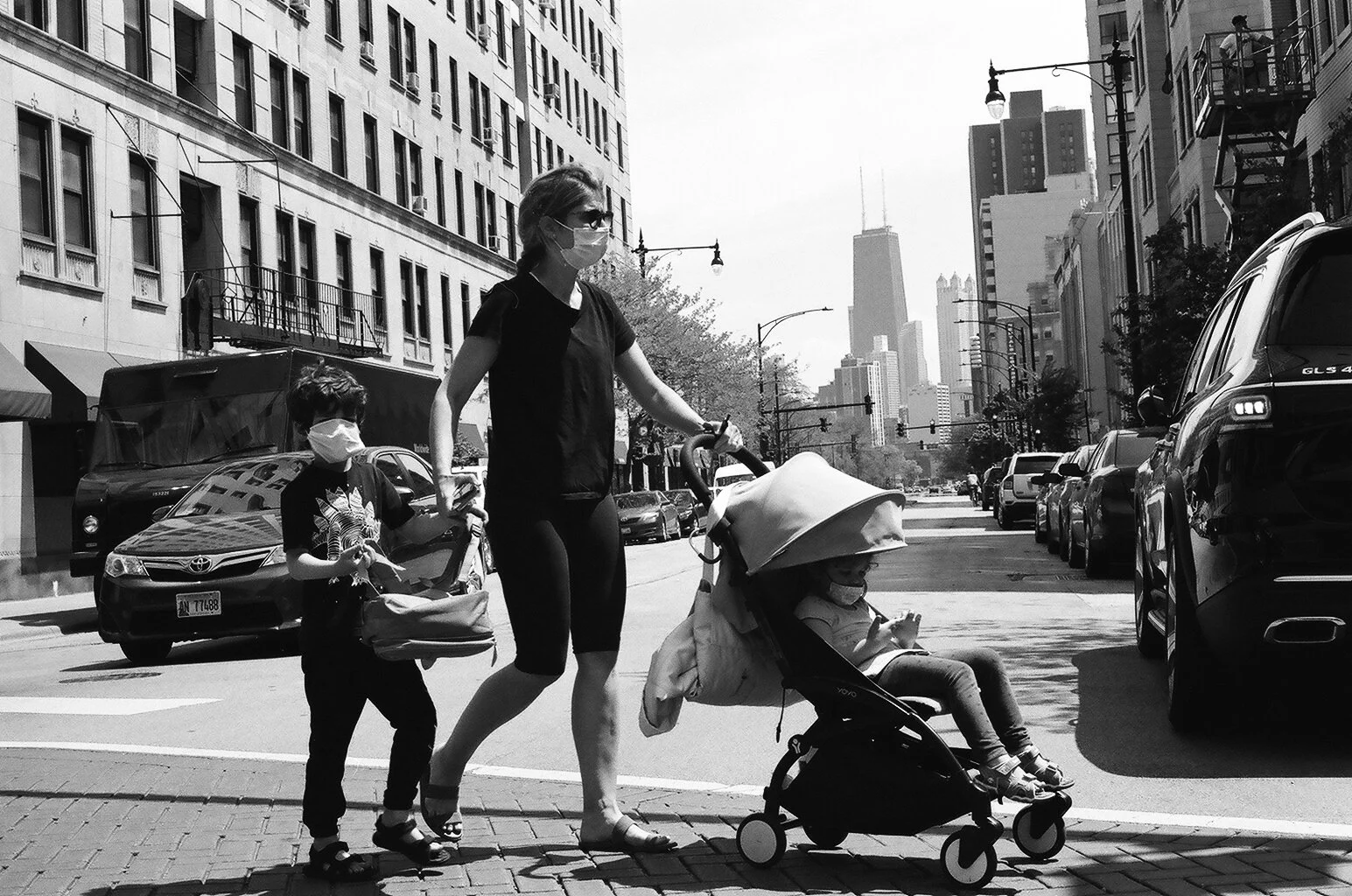
A mother pushes a stroller across a downtown Chicago street while she and her children wear masks outdoors, the skyline rising behind them.
The image shows how caution extended beyond enclosed spaces and into open air. What began as emergency guidance moved into daily habit, reshaping how families navigated even the most ordinary public moments.
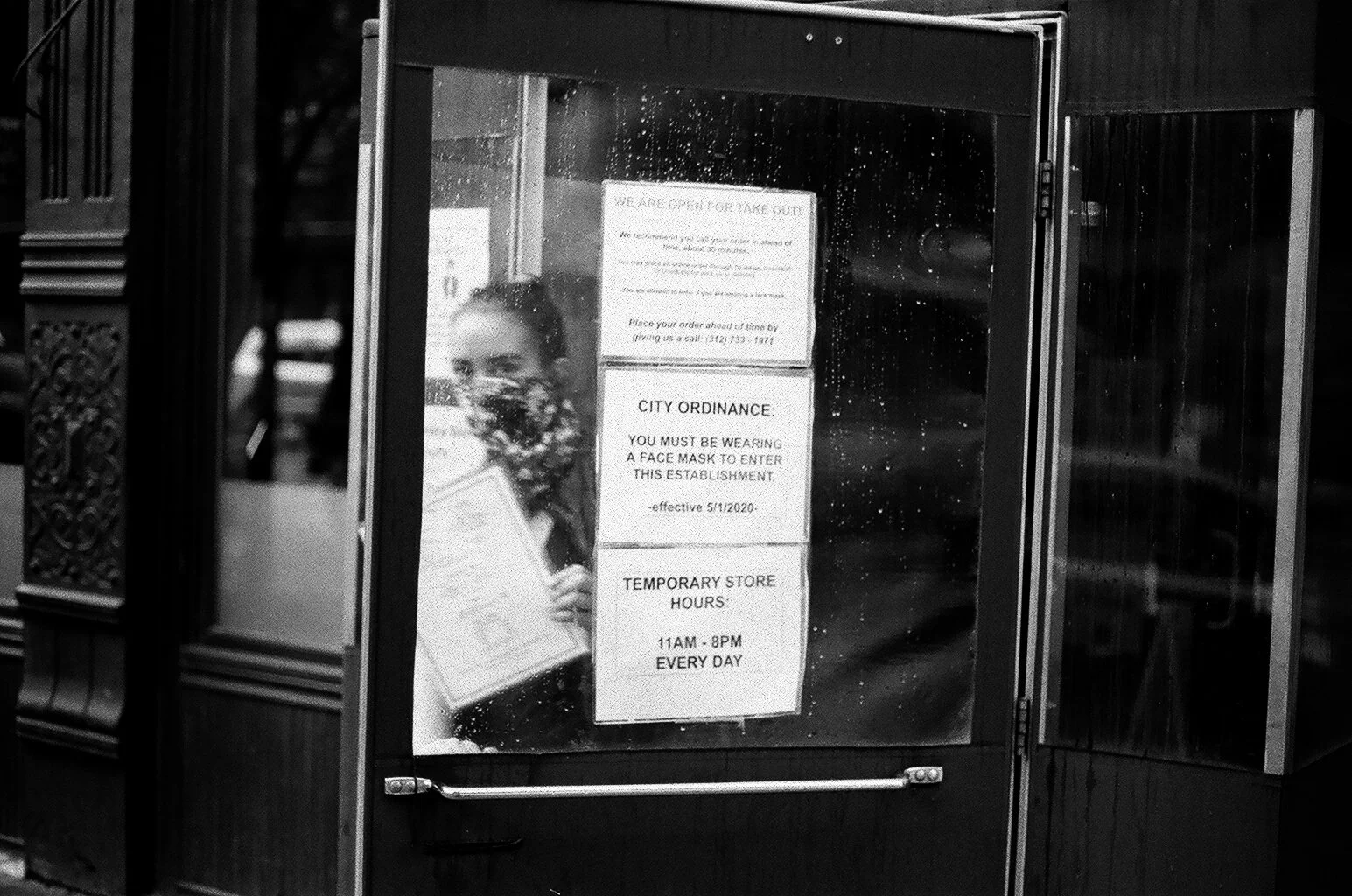
A woman exits a restaurant as mask mandates and temporary hours cover the door.
Orders were placed online and picked up without conversation. QR codes replaced conversation. Survival became transactional and contact optional. In the Digital Migration, human interaction was no longer required to participate in daily life.
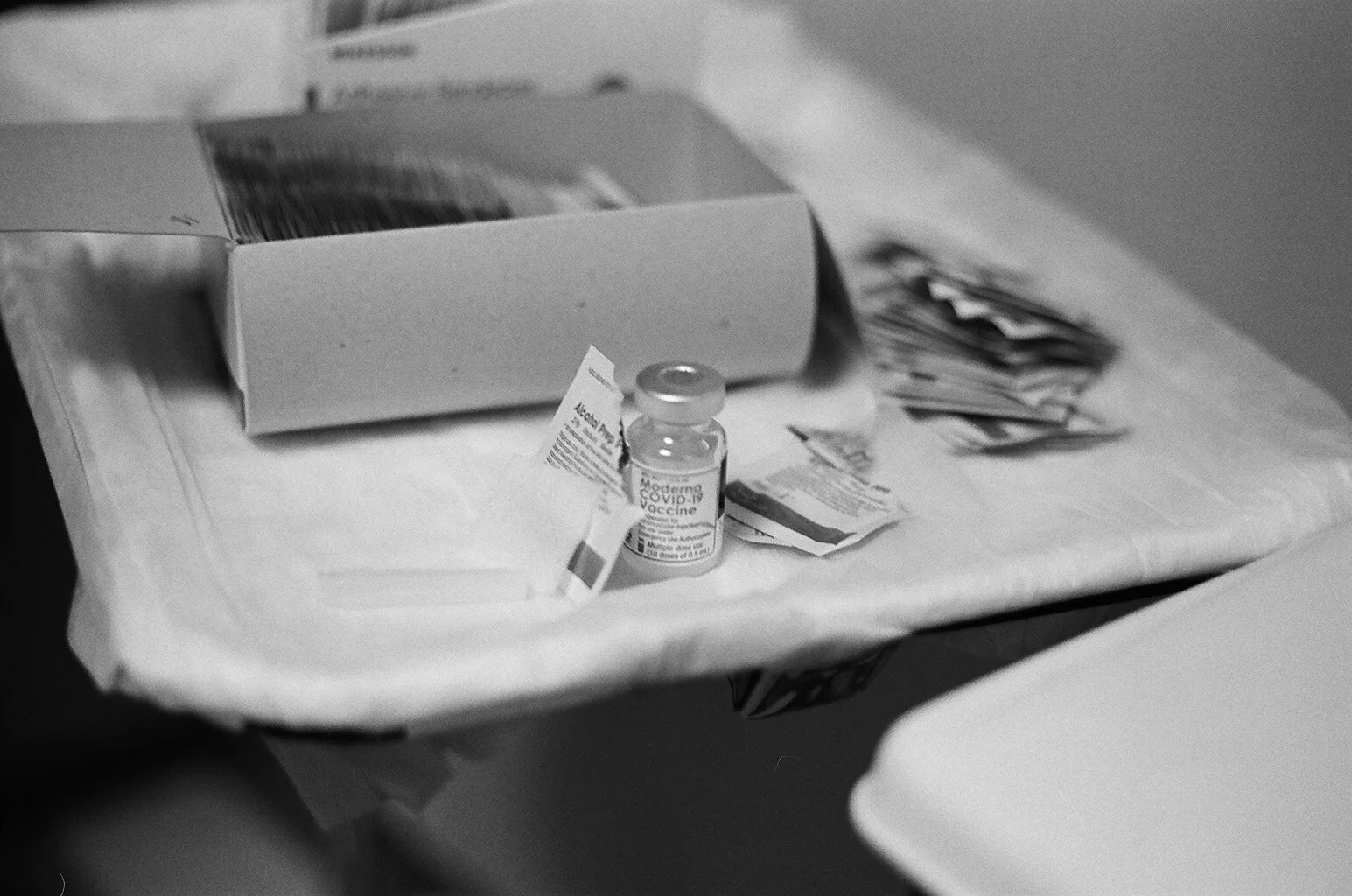
A small vial of COVID-19 vaccine rests on a medical tray beside alcohol swabs and a syringe.
The vaccine marked a turning point, shifting the narrative from endurance to intervention. It carried hope, skepticism, relief, and division all at once, becoming both a scientific milestone and a cultural fault line in the story of survival.
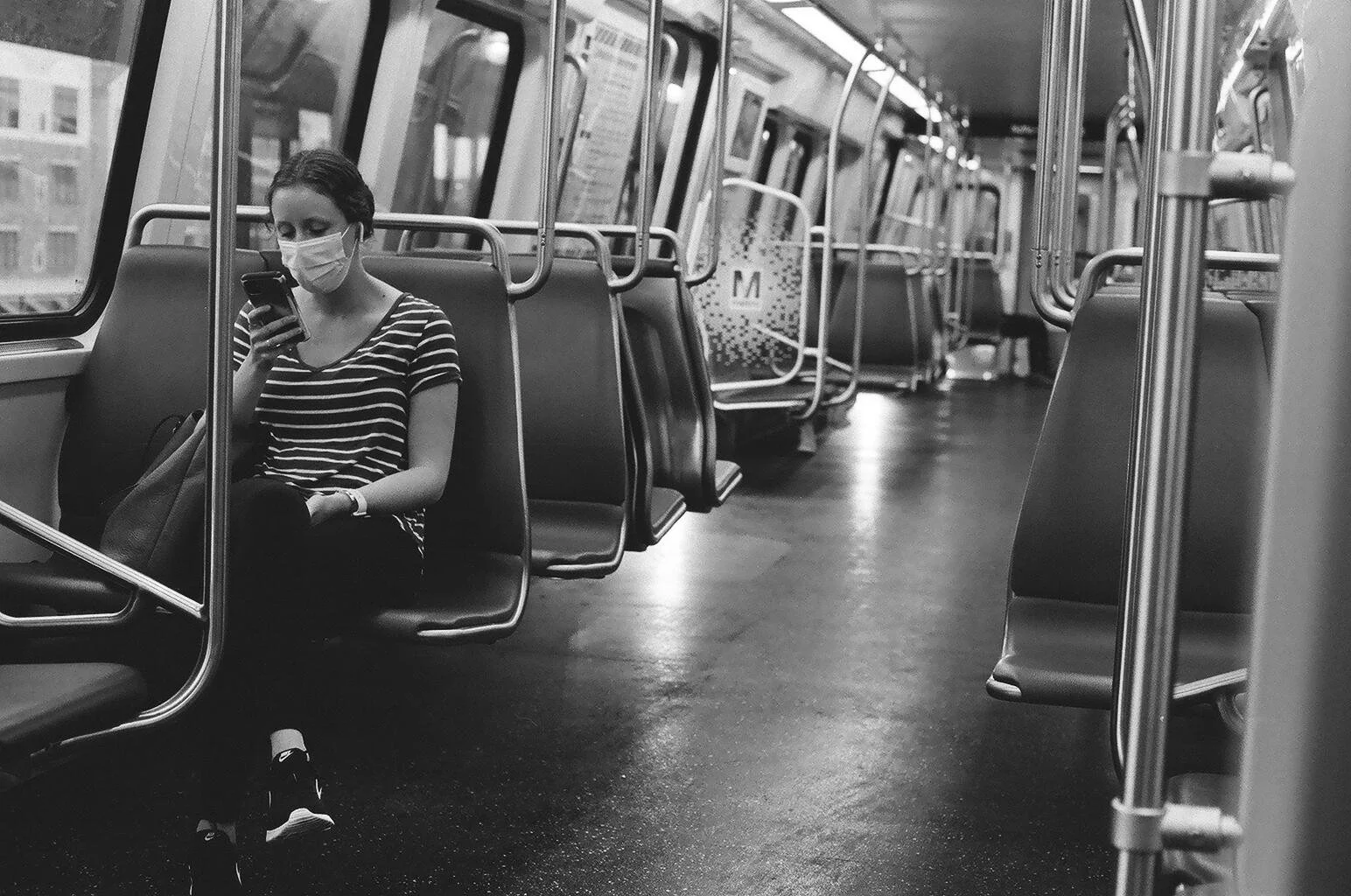
A masked woman sits alone on a nearly empty Metro car in Washington DC, absorbed in her phone as rows of vacant seats stretch behind her.
Public transportation continued to run, but without its public. Isolation moved into shared spaces, and the phone became the primary connection to news, work, relationships, and culture. This image reflects a shift in human interaction, where physical presence thinned and digital life expanded to fill the silence.
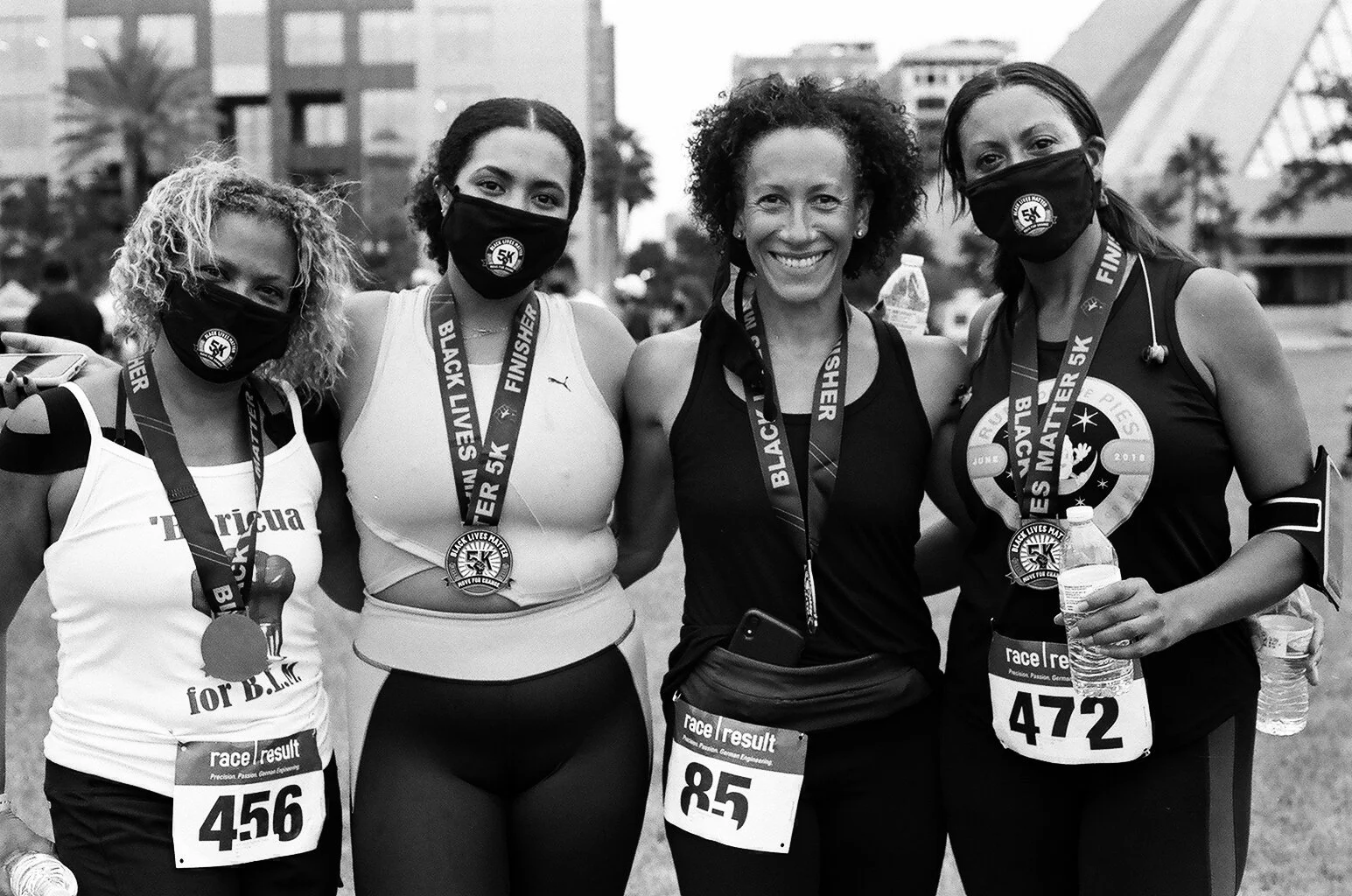
Four women stand together after completing a race, medals around their necks and Black Lives Matter masks covering their faces.
Amid lockdowns and distancing, public protest and cultural reckoning did not pause; they intensified. Even as society separated physically, collective identity found new forms of expression, merging activism, sport, and shared visibility in a moment shaped as much by screens as by streets.
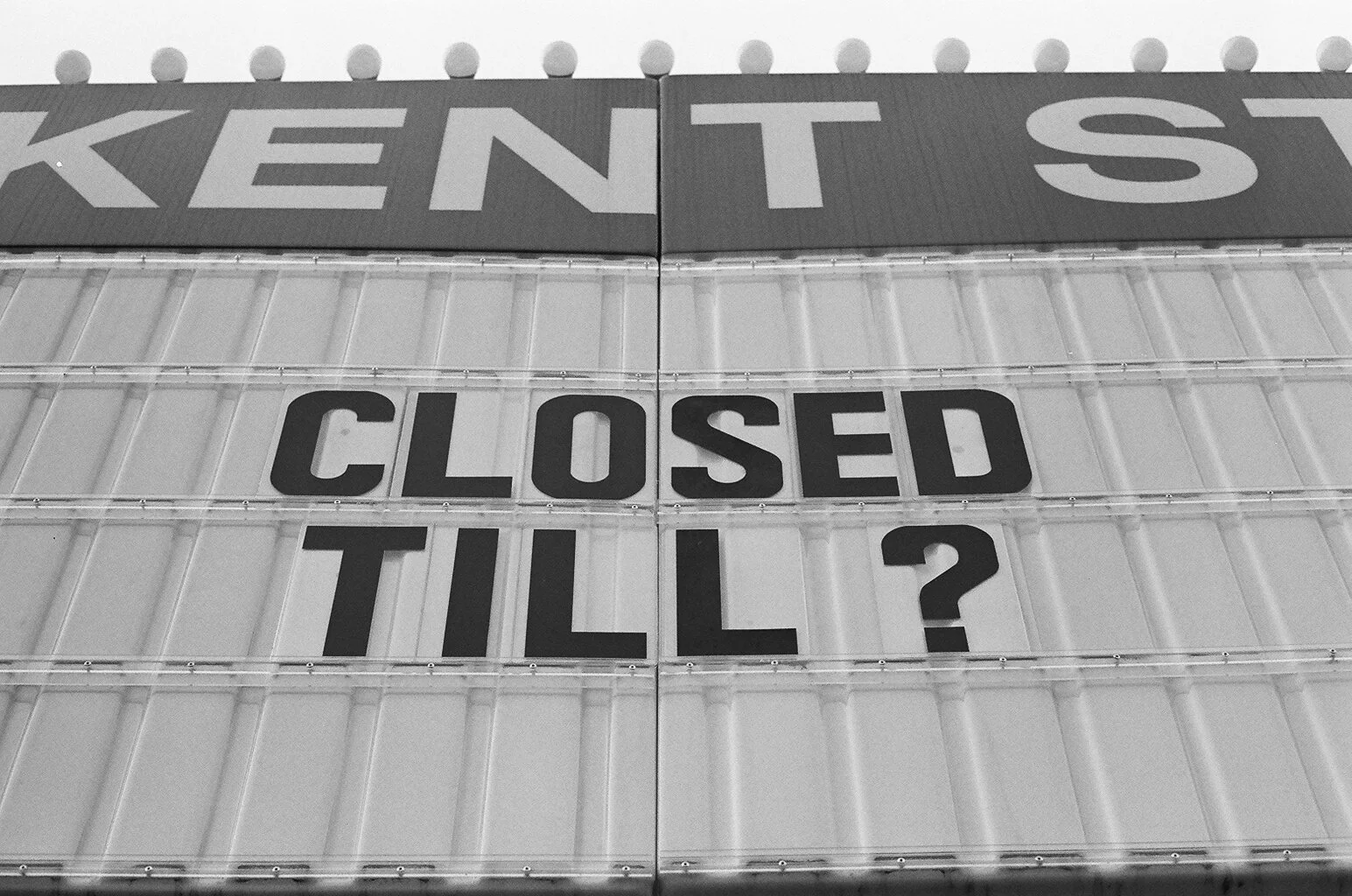
The marquee of The Kent Stage in Kent, Ohio reads “CLOSED TILL?” beneath its bold lettering.
The unanswered question captures the uncertainty that defined the cultural shutdown. Theaters, music, and gathering spaces went dark without a timeline, freezing performance and communal experience in suspension.
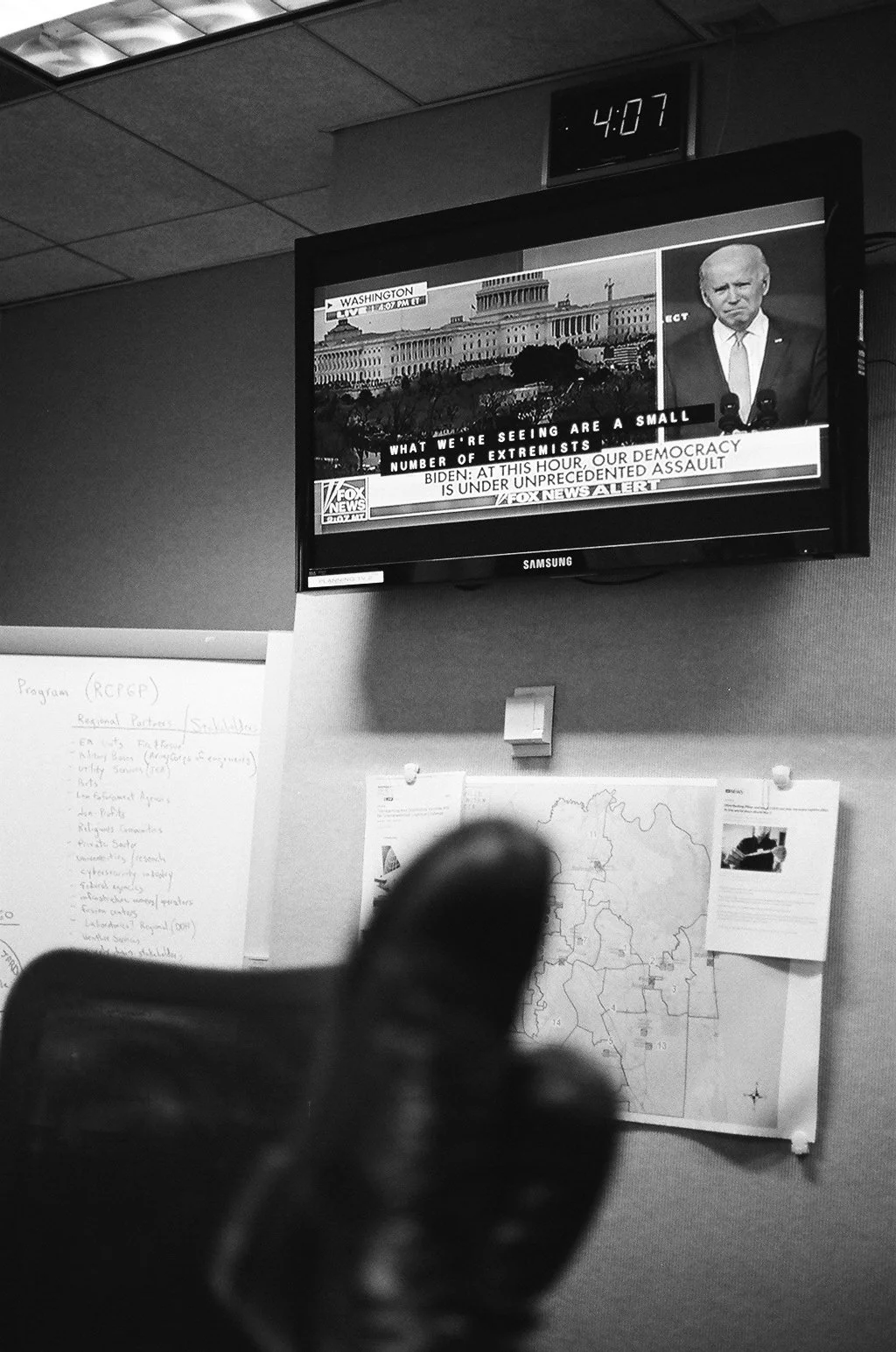
A television mounted on a wall broadcasts breaking news of an attack on the U.S. Capitol on January 6th while a clock above it marks the hour.
In the middle of a global pandemic, political instability unfolded in real time, compounding uncertainty with crisis. The image reflects how layered the moment became, with public health fear and democratic anxiety colliding inside the same confined spaces where people were already living in isolation.
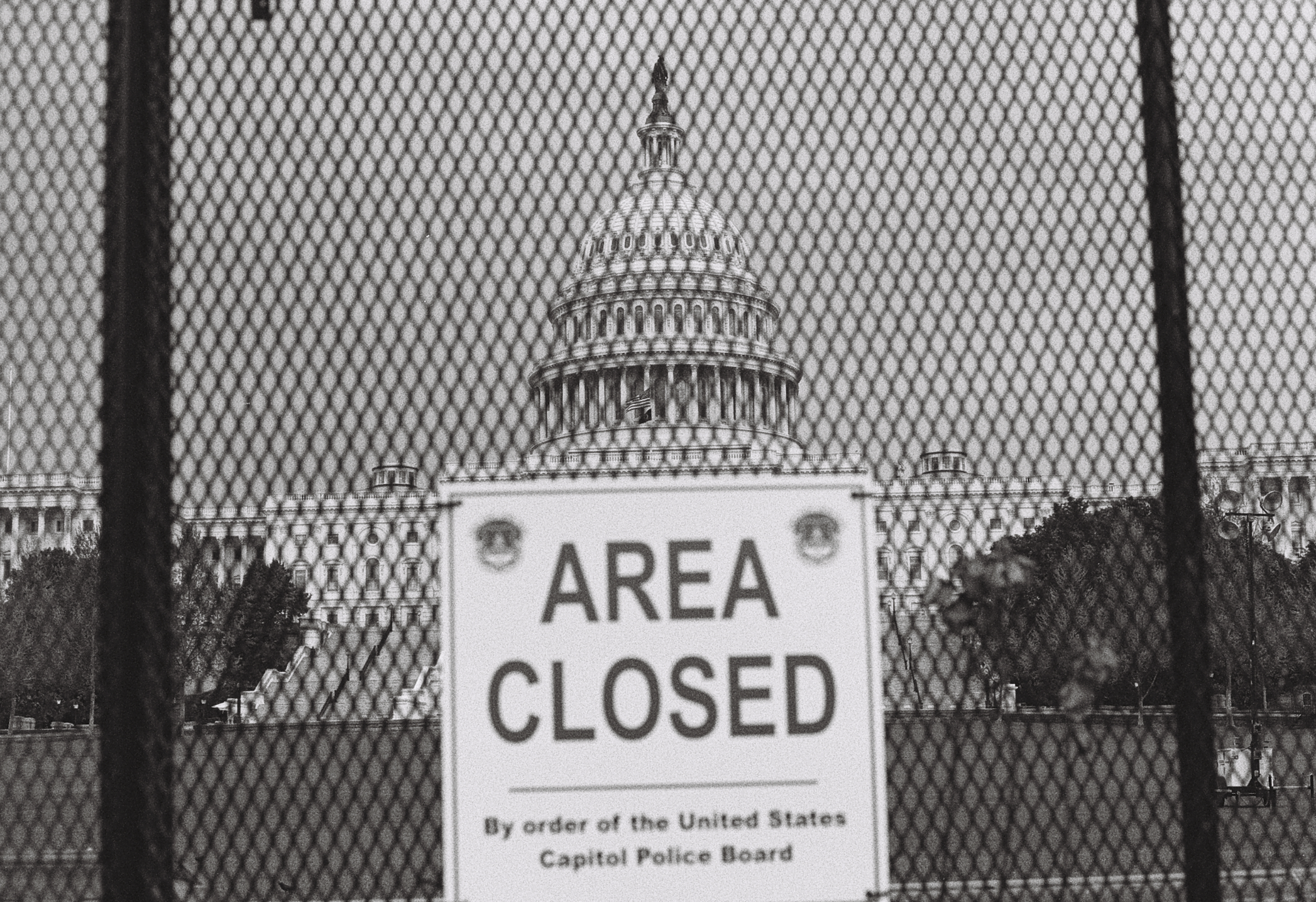
A sign reading “Area Closed” hangs on a security fence with the U.S. Capitol blurred behind it.
The day after the attack, Washington, D.C. moved into total lockdown. In a year already defined by restriction and fear, the image shows how crisis layered upon crisis, turning the symbolic heart of democracy into a barricaded space. The events were seen by the entire world real time due to social networks and streaming networks.
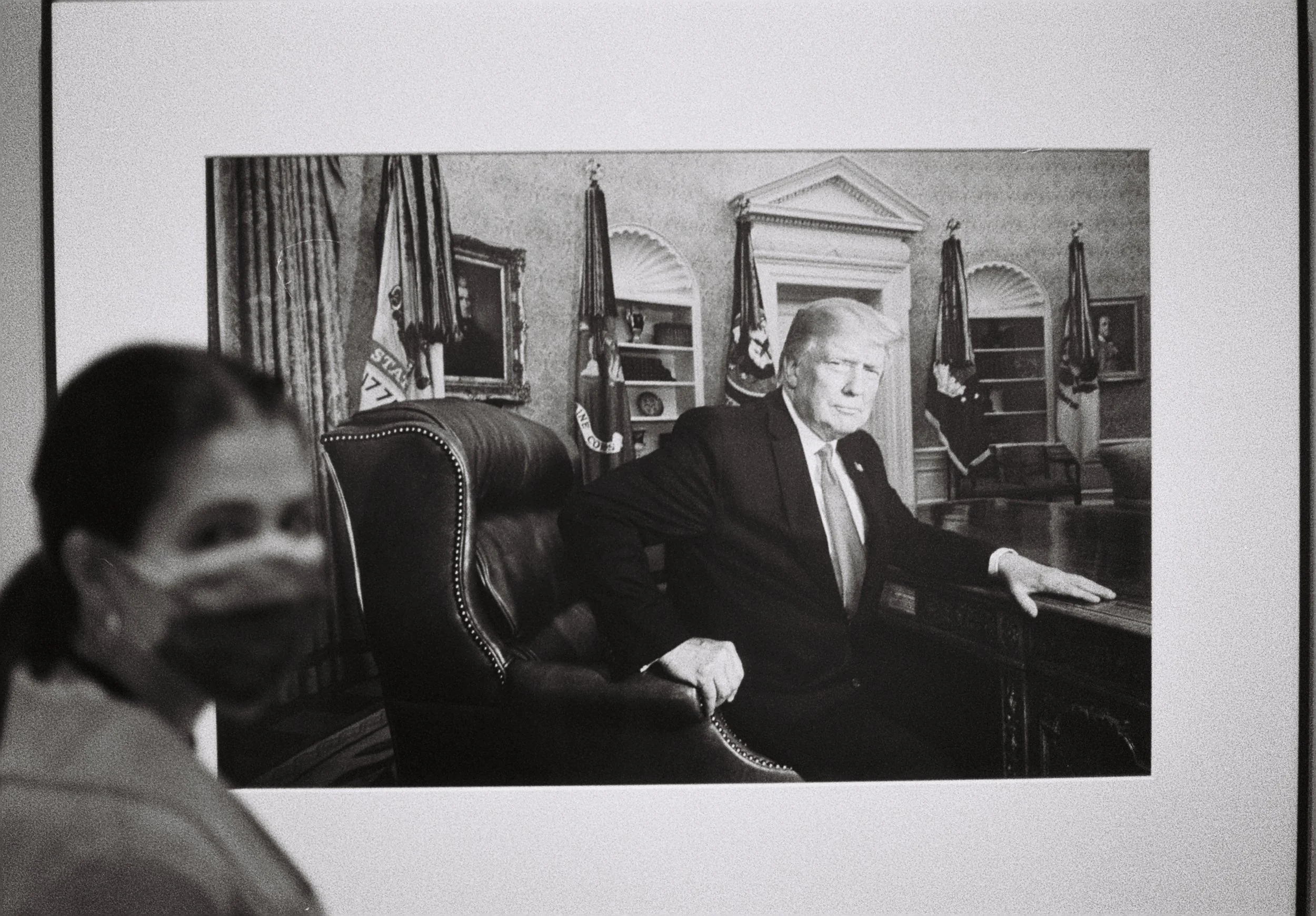
A woman wearing a mask passes in the foreground of a presidential portrait hanging inside the National Portrait Gallery in Washington, D.C.
The image juxtaposes state authority with civilian compliance during a period of national crisis. It also underscores how modern power is exercised through screens, as political leadership relied on social media and the internet to command attention, shape narrative, and sustain influence in a world already migrating online.
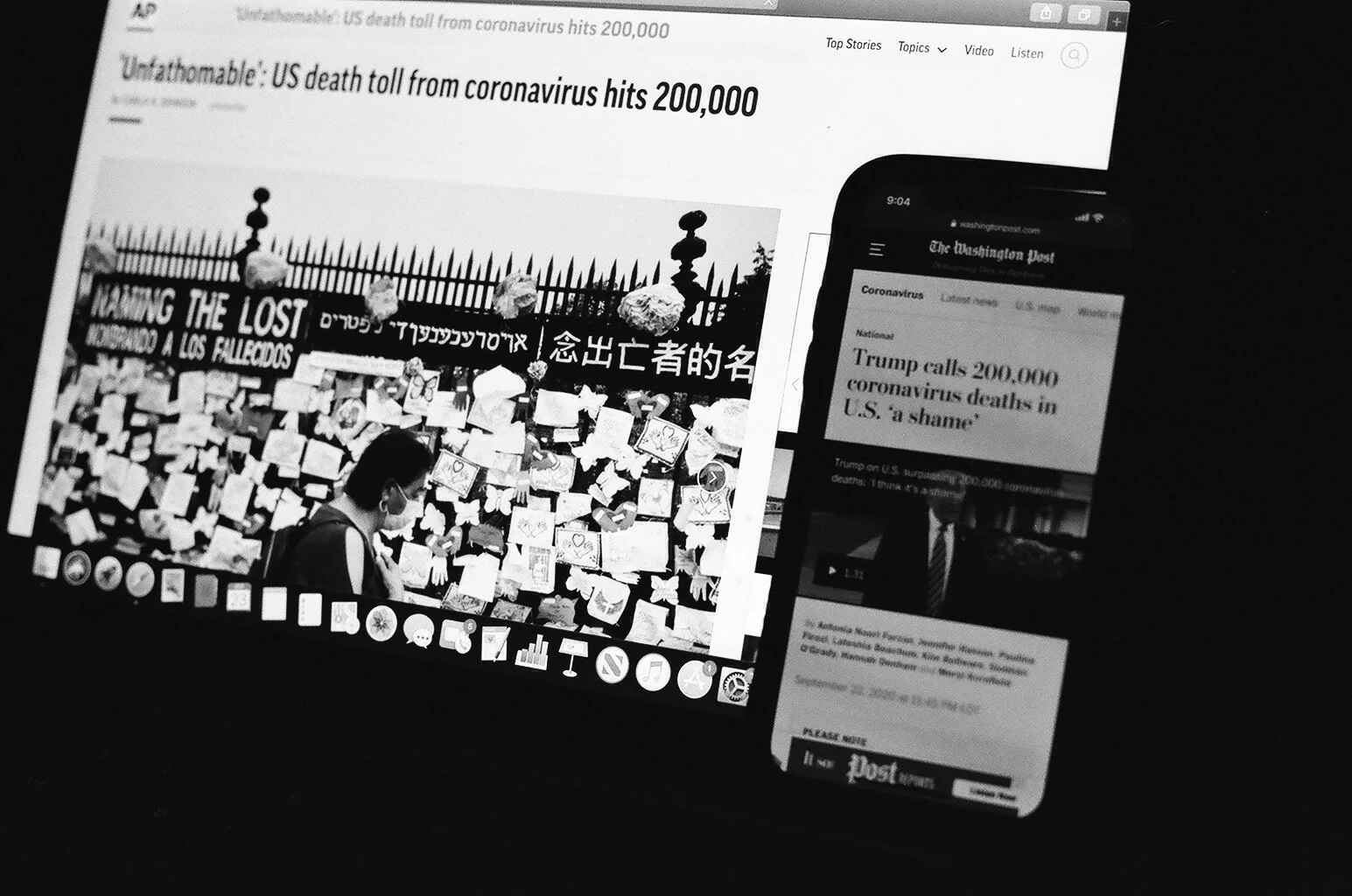
A computer screen and phone display headlines announcing that the U.S. coronavirus death toll has reached 200,000.
The number is presented as statistic, but it represents individual lives, families, and absence. In the isolation of lockdown, news became constant and inescapable, and the scale of loss unfolded through screens rather than public mourning, turning grief into a daily headline.
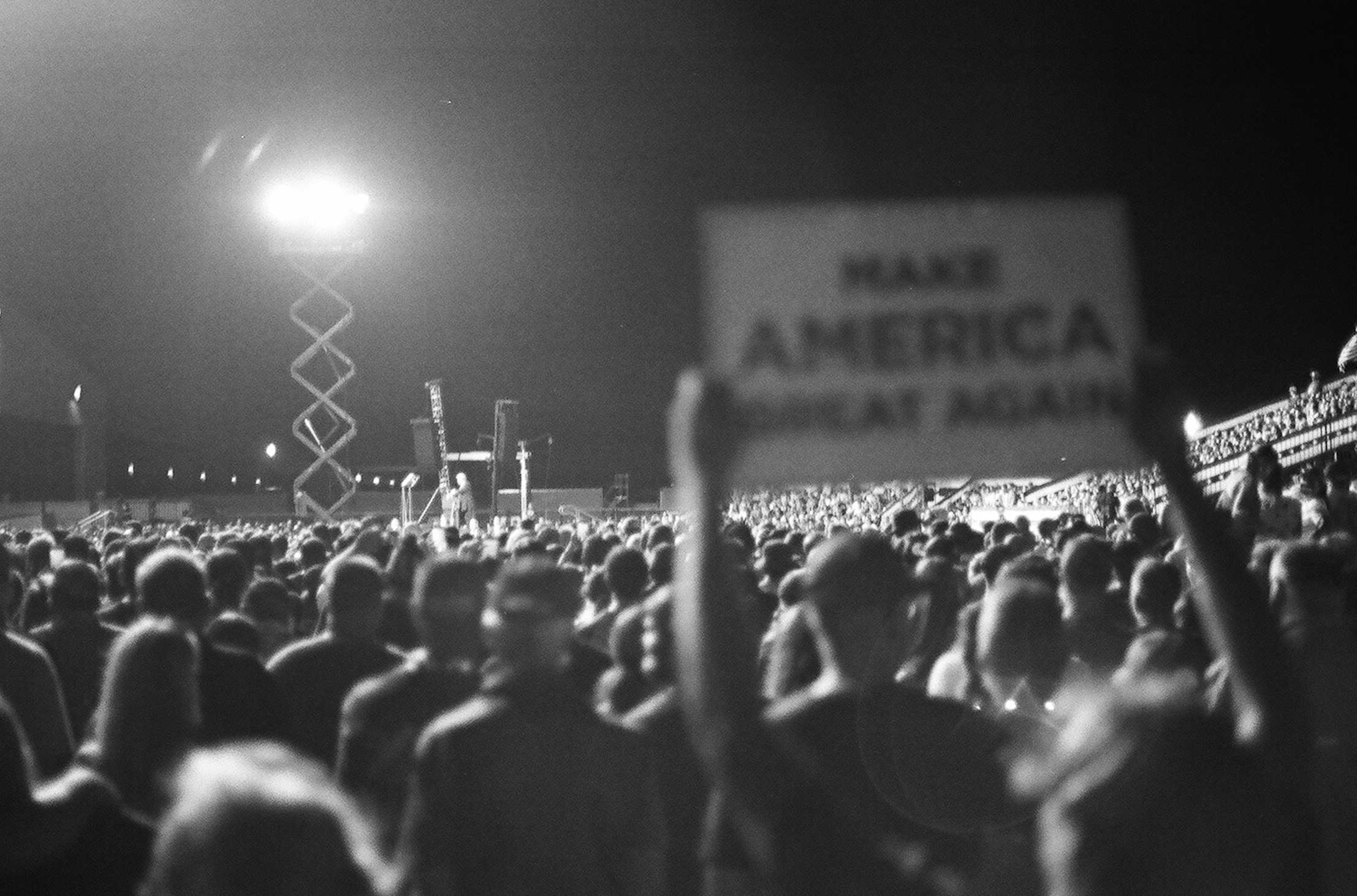
A dense nighttime crowd gathers at a presidential campaign rally, a “Make America Great Again” sign raised above the audience.
Held on September 23, 2020, only days after the United States surpassed 200,000 COVID 19 deaths, the event was widely described by critics and public health officials as a COVID “super-spreader” event. The rally stood in direct contrast to guidance issued by the Centers for Disease Control and Prevention, reflecting a period when federal public health policy and political mobilization moved in opposing directions.
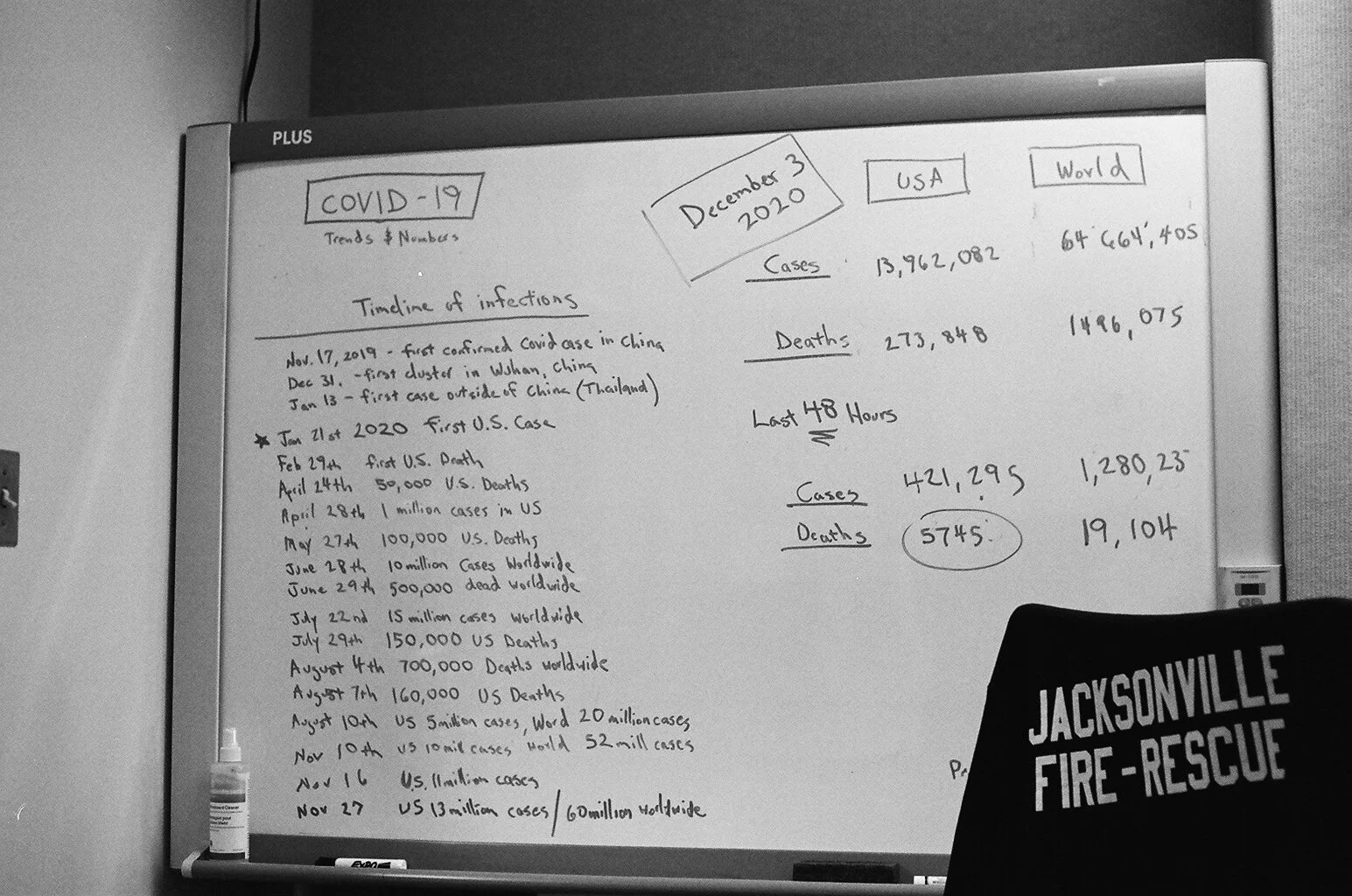
Inside the Jacksonville Fire and Rescue Department headquarters, a Department of Homeland Security whiteboard tracks COVID-19 cases and deaths in rising numbers and dates.
The pandemic was monitored as an operational reality, not an abstract headline. In this room, statistics translated into staffing, response, and frontline risk, revealing how crisis moved from news cycle to daily emergency management.
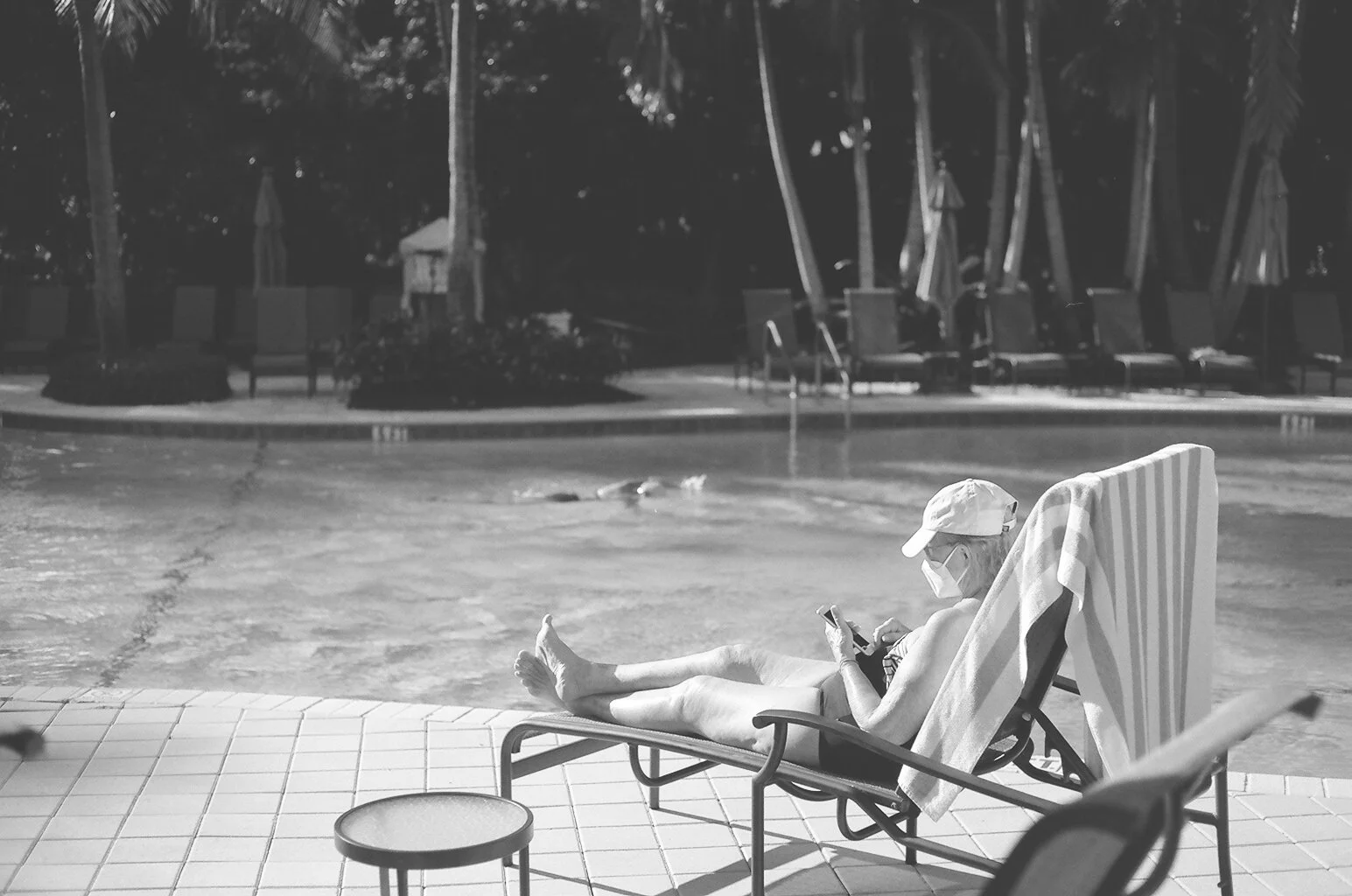
An elderly woman sits poolside wearing a mask, looking down at her phone while a swimmer moves through the water.
Leisure persists, but caution remains visible even in spaces designed for rest. The moment captures how physical environments reopened while attention and interaction continued to shift toward the device, reinforcing a quiet retreat into mediated connection.
A handwritten note taped to the inside of a door acts as a reminder to the homeowner.
The message sits at the threshold between private space and the outside world. It marks the moment when stepping out the door required preparation, when the ordinary act of leaving home carried new rules, new caution, and a constant reminder that the world beyond had changed.
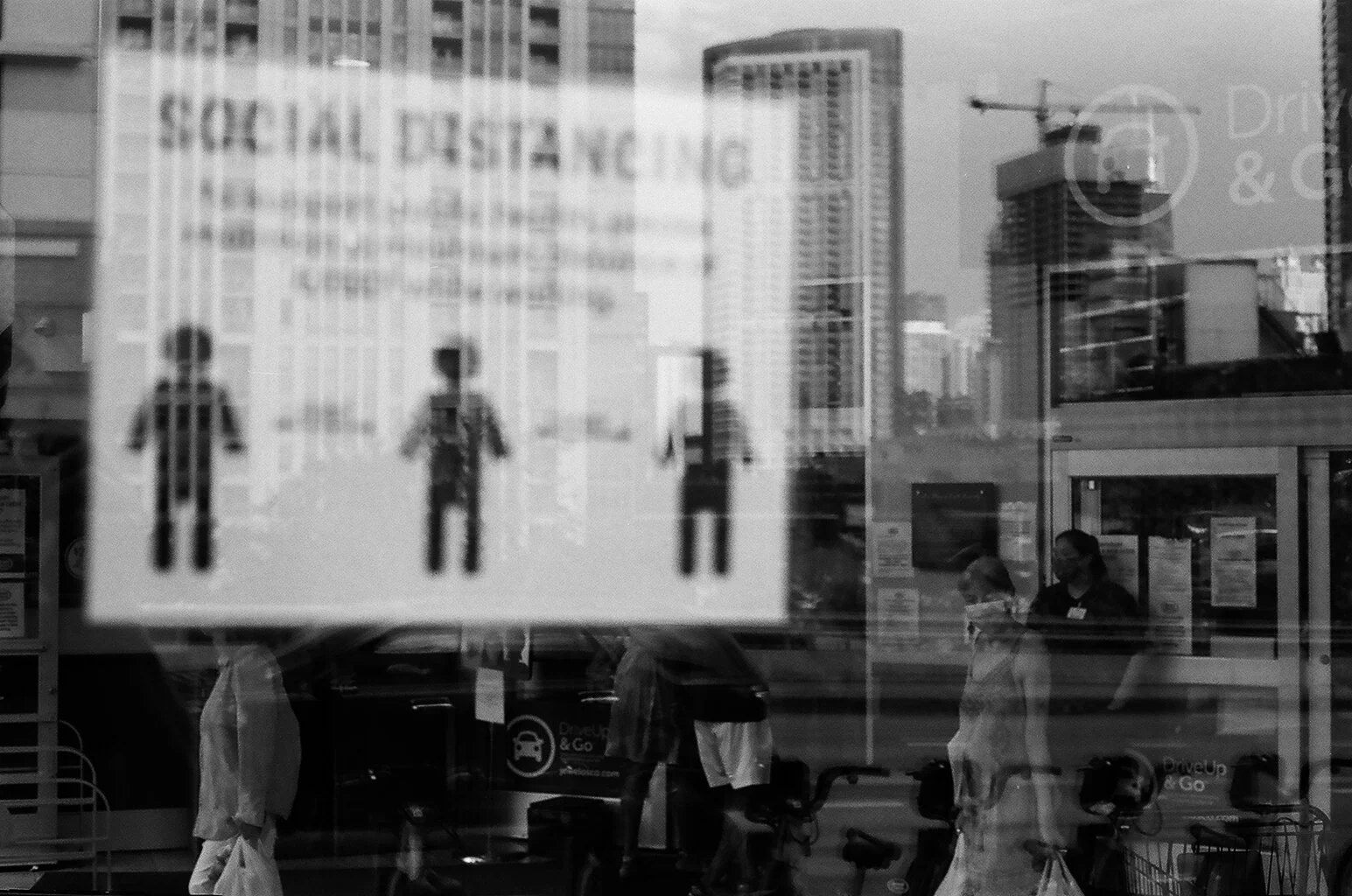
A sign instructing customers to maintain social distance hangs in the foreground as masked figures move through a grocery store beyond the glass.
The phrase “social distancing” entered everyday language and reshaped how bodies occupied space. Ordinary errands became calculated movements, and even the act of buying food carried the weight of caution, scarcity, and measured separation.
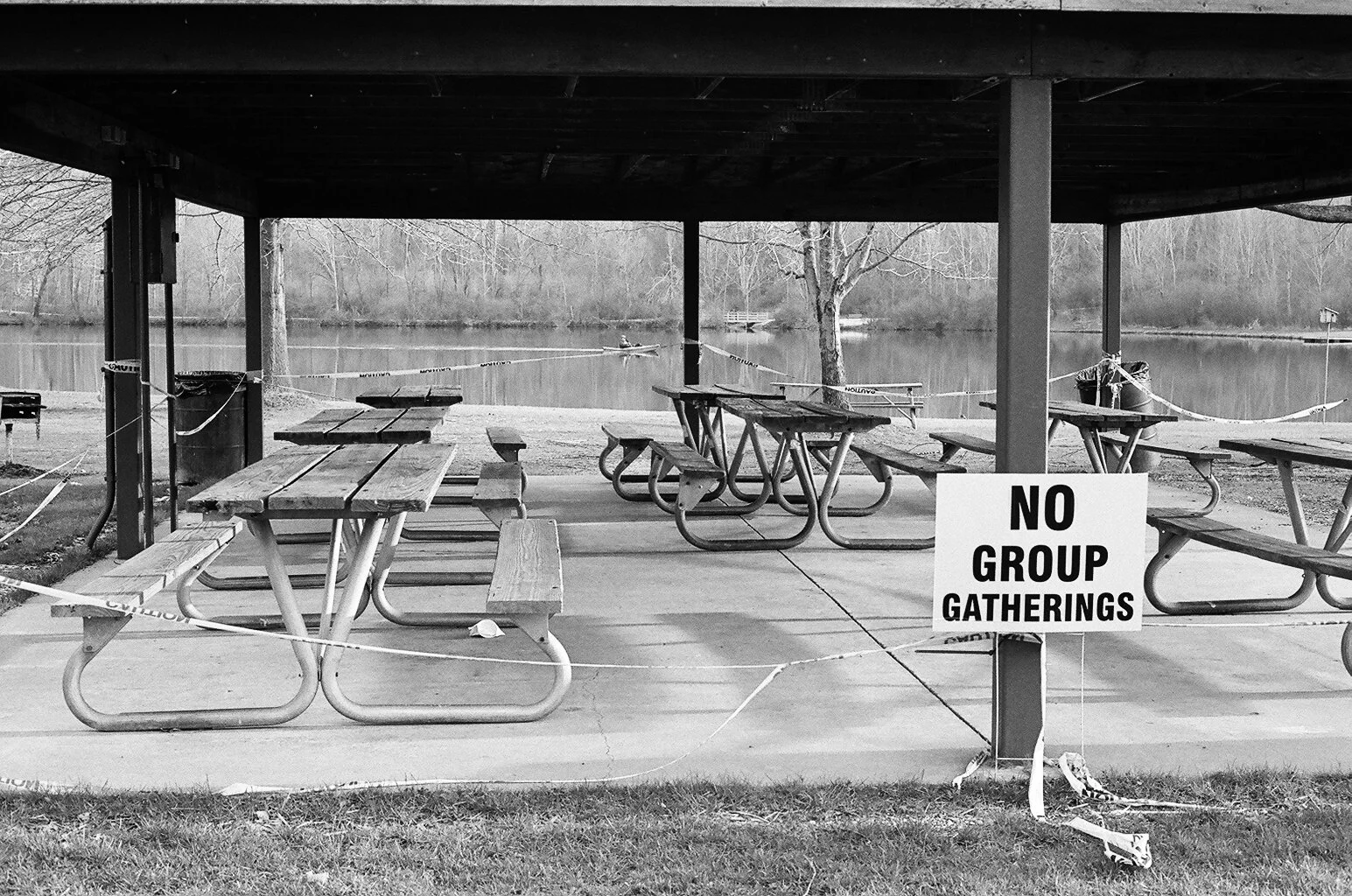
Empty picnic tables sit roped off beneath a shelter marked “No Group Gatherings.”
Public space was physically restrained, transforming parks and pavilions into zones of restriction rather than community. As collective life was suspended outdoors, connection increasingly migrated elsewhere, reinforcing a culture where interaction became conditional and often mediated at a distance.
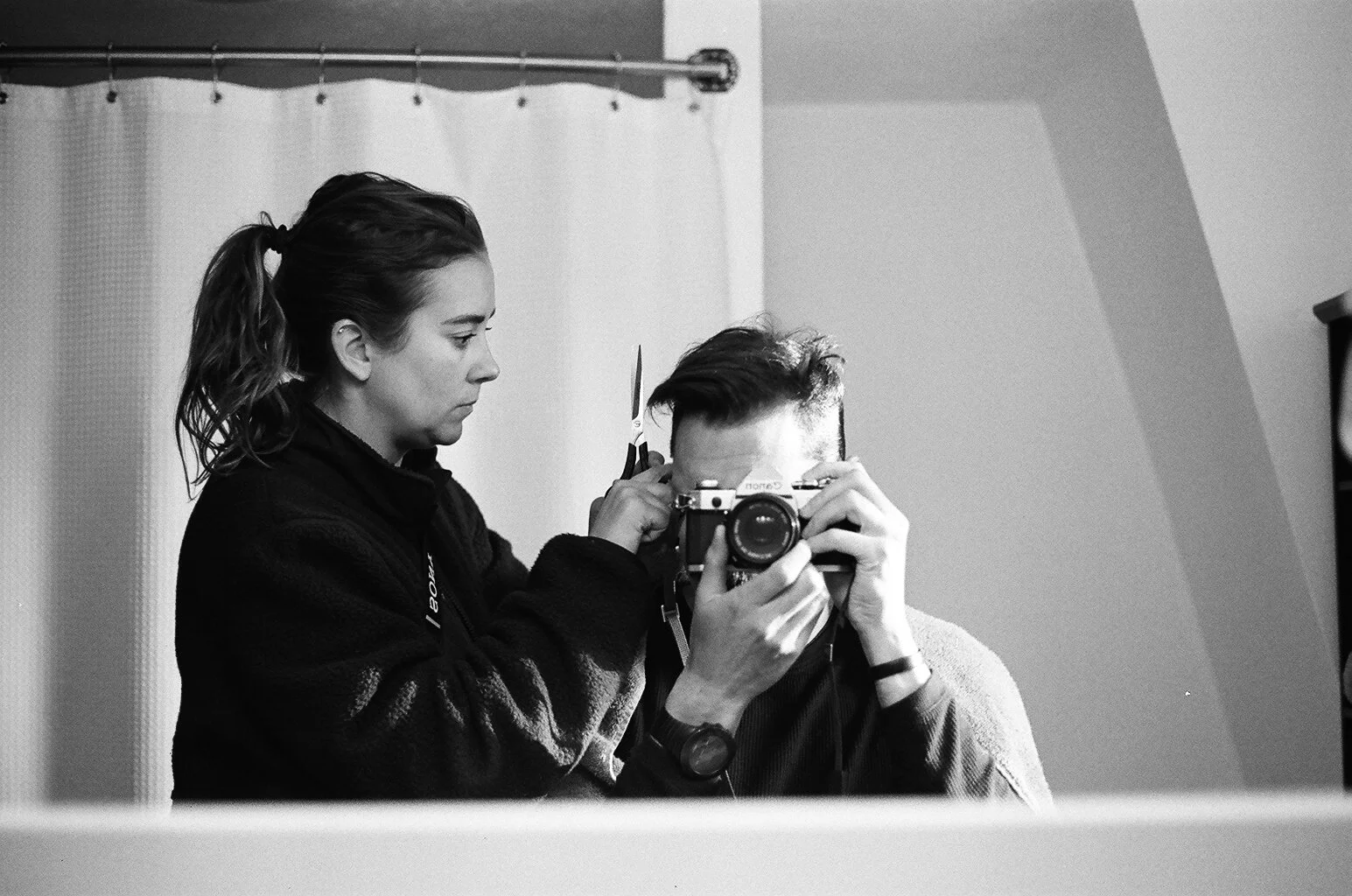
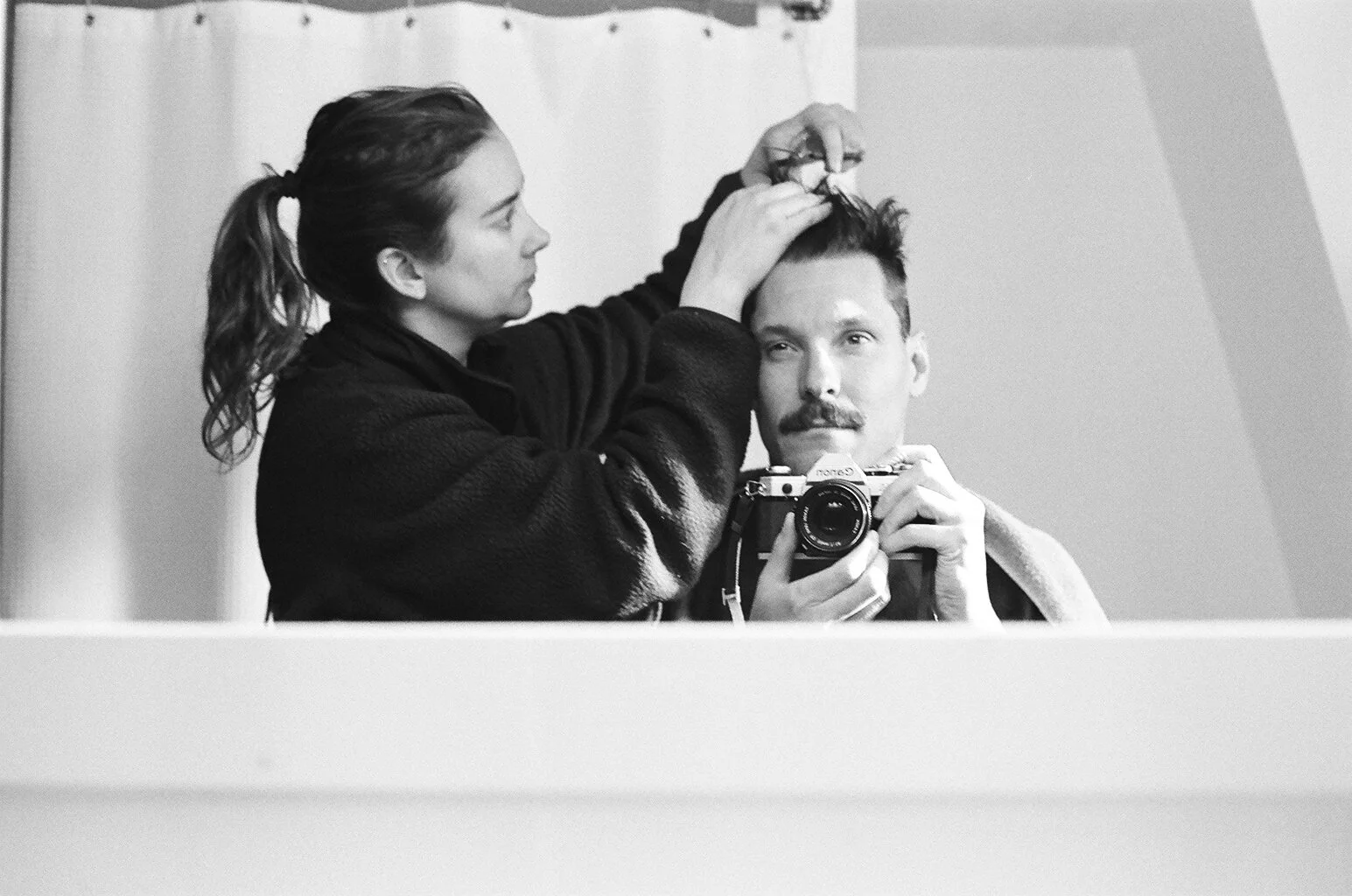
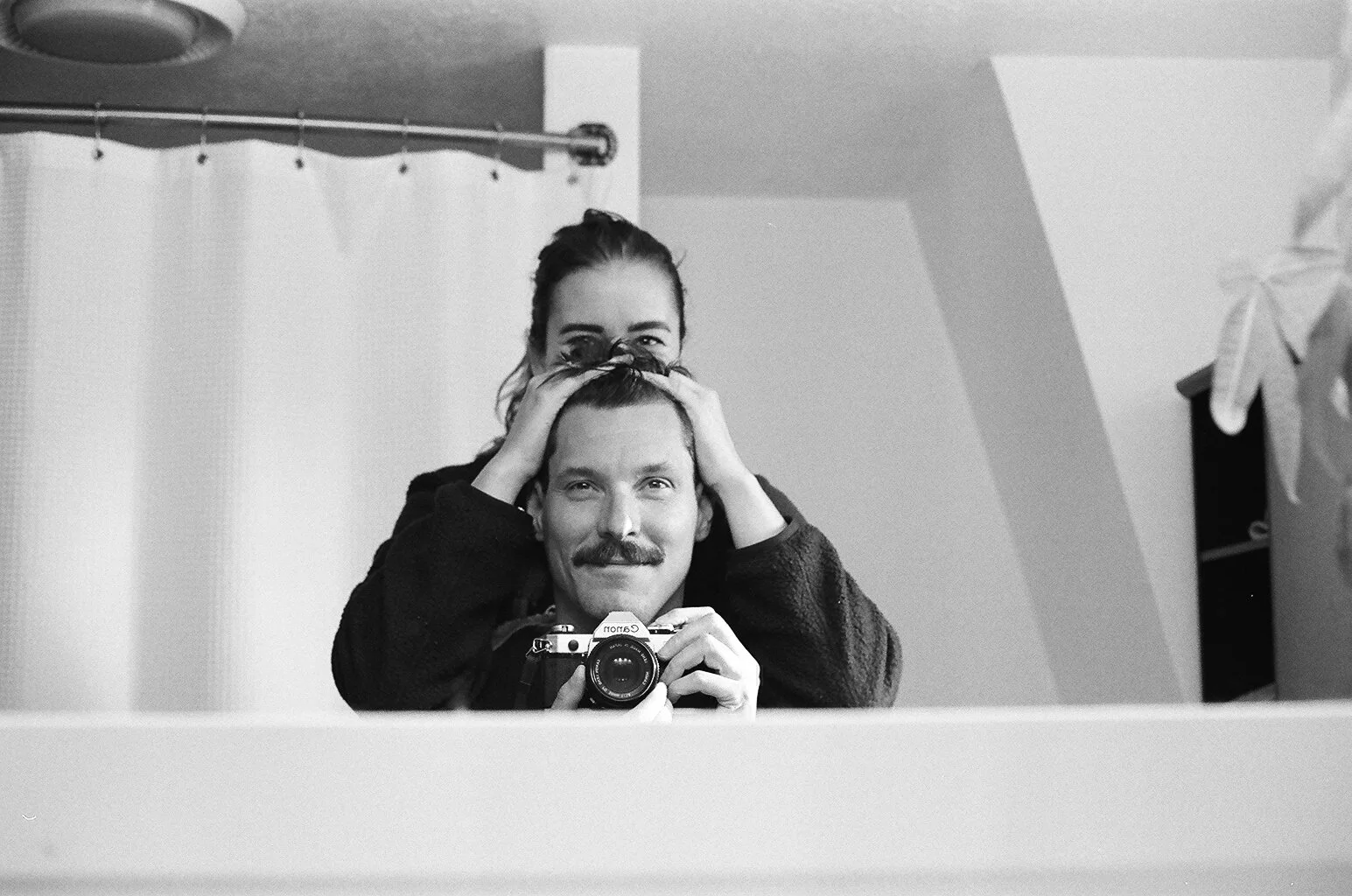
Three images show a woman giving a man a haircut at home, reflected in a bathroom mirror as he photographs the moment.
This is how many experienced the pandemic: isolated inside their homes, adapting in real time. In the absence of institutions, people relied on neighbors and friends, revealing that even in separation, survival depended on small acts of shared humanity.
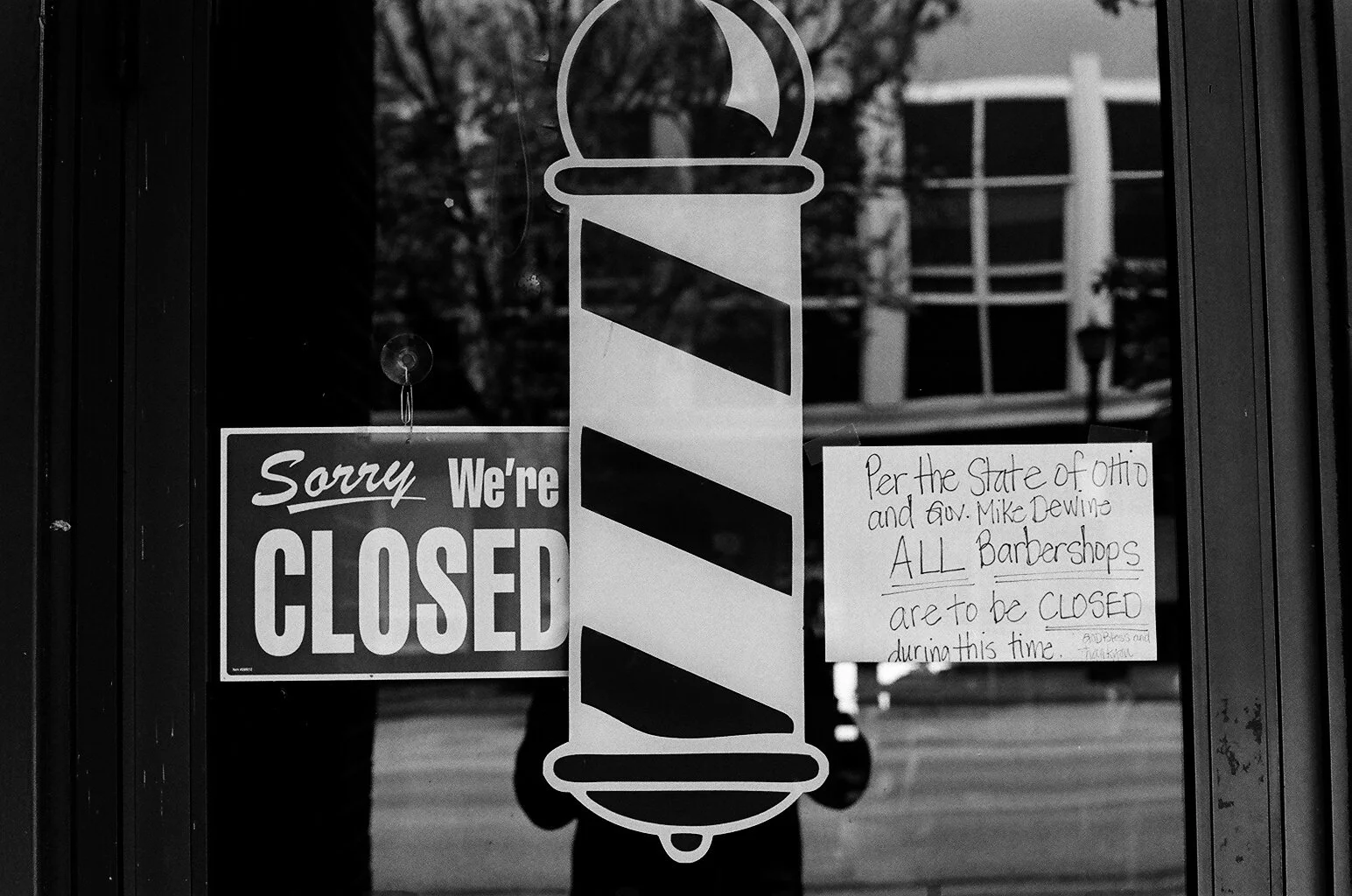
A barbershop owner hangs a sign marked “Sorry We’re Closed,” beside a handwritten notice citing the governor’s order to shut all barbershops.
Personal routine and physical touch were halted by state mandate, and the language of blame entered the storefront window. As doors locked, frustration and debate migrated online, where authority, compliance, and resistance were increasingly performed on screens rather than across counters.
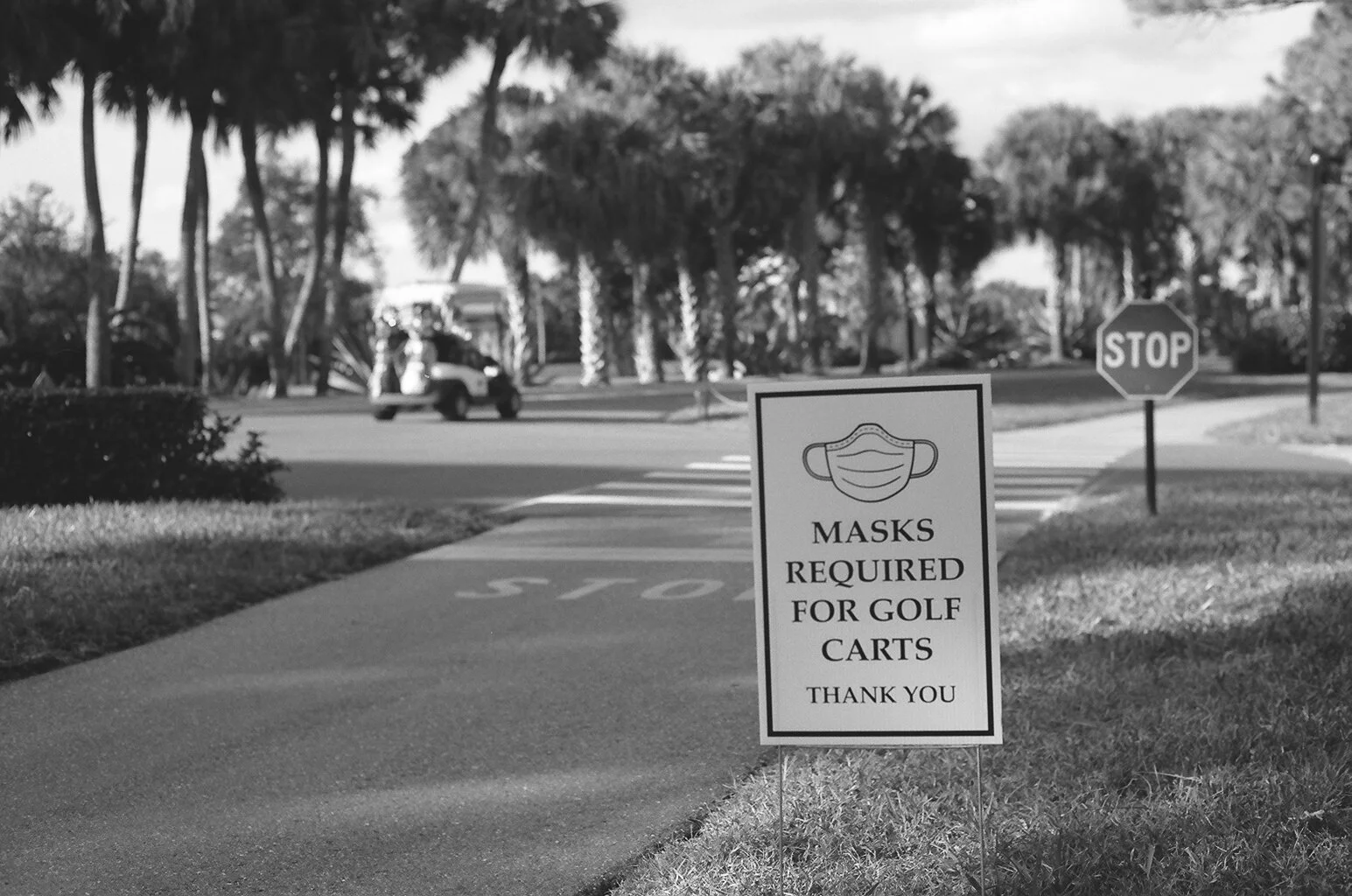
A sign at the entrance to a golf course community reads, “Masks Required for Golf Carts.”
Country clubs and gated golf communities were not insulated from disruption; even spaces associated with wealth and exclusivity adopted mandates and restrictions. The pandemic cut across class lines, and like the rest of the country, these communities became sites of compliance, resistance, and quiet polarization.
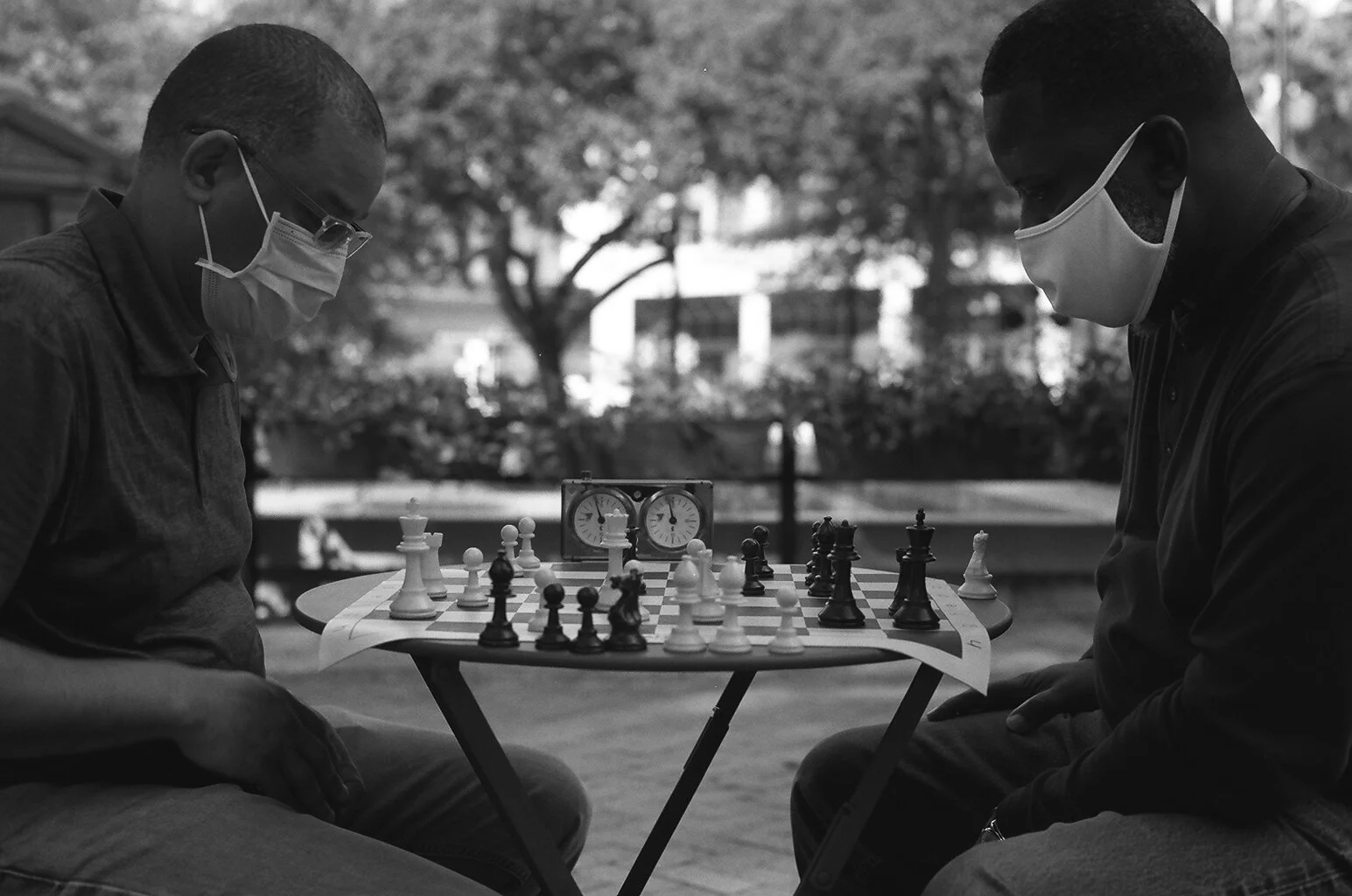
Two men sit across from one another in a public park, both wearing masks as they study a chessboard between them.
An ancient game built on direct confrontation and visible expression is now played behind fabric and caution. Even outdoors, even in stillness, interaction is regulated and partially obscured. The image captures a cultural collision, where human ritual persists but is reshaped by separation, signaling a world increasingly conditioned to filter connection through precaution and distance.
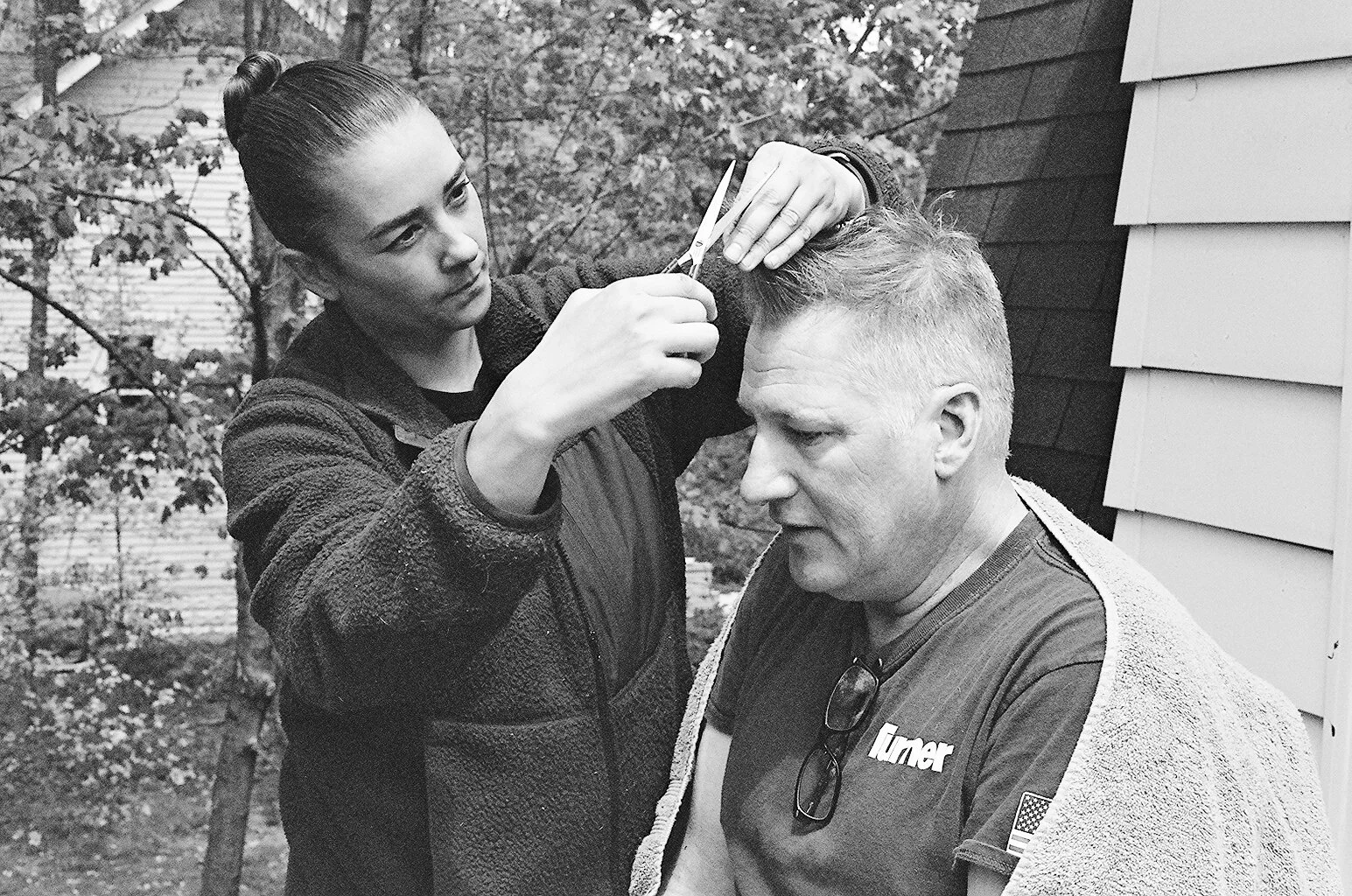
A woman, not a professional barber, cuts her neighbor’s hair on a porch after barbershops were ordered closed.
“Home haircuts” became common language as ordinary citizens replaced licensed services out of necessity. Institutional space dissolved into private improvisation, signaling how quickly structured systems gave way to decentralized, informal solutions rooted in proximity and adaptation.
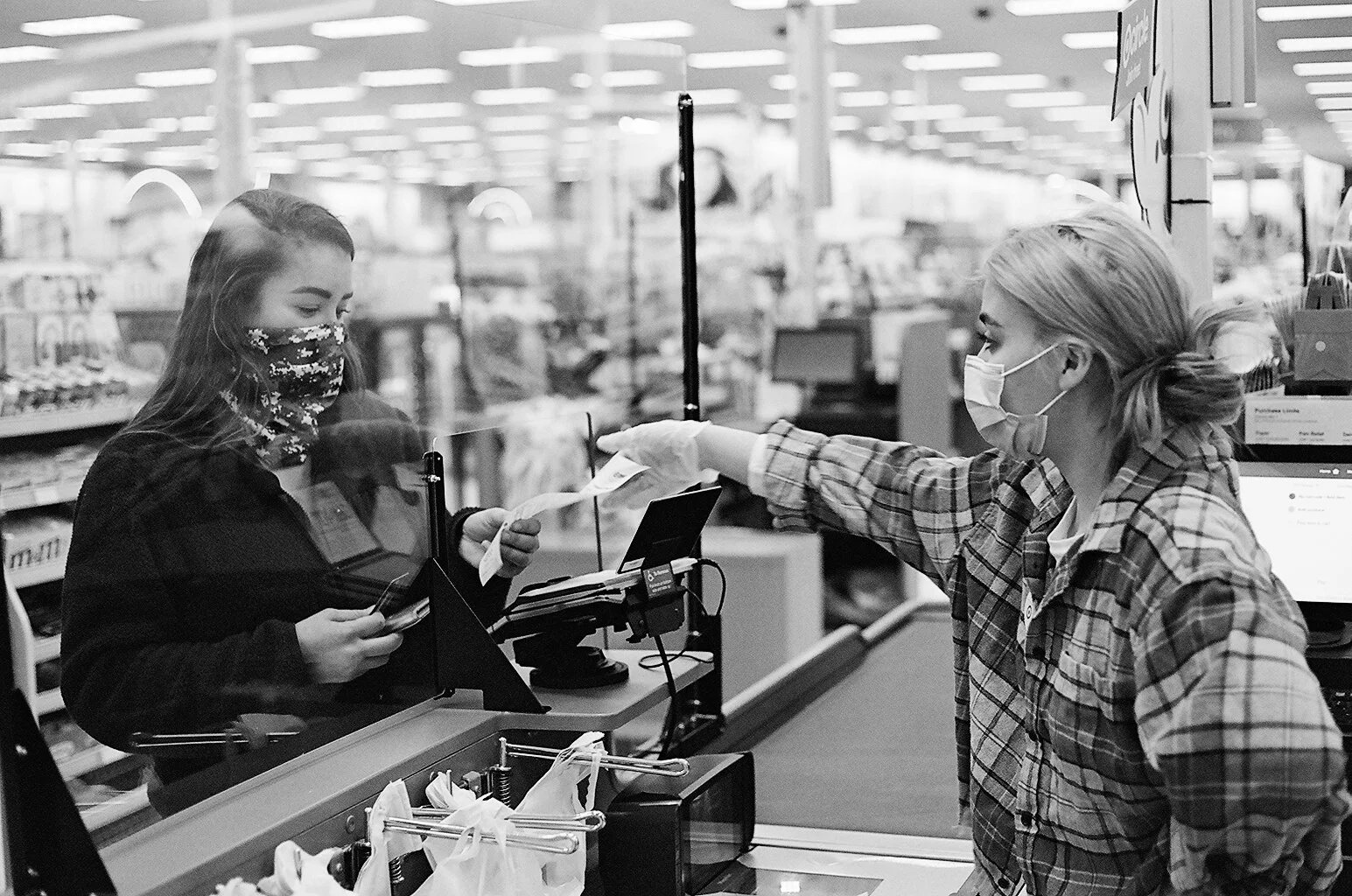
A masked cashier and customer complete a transaction through plexiglass, their hands separated as a receipt passes between them.
Cash disappeared and payments became tap only, removing touch from exchange. The moment reflects a rapid acceleration toward contactless systems, where even money shifted from physical object to digital signal, further distancing human interaction from the act itself.

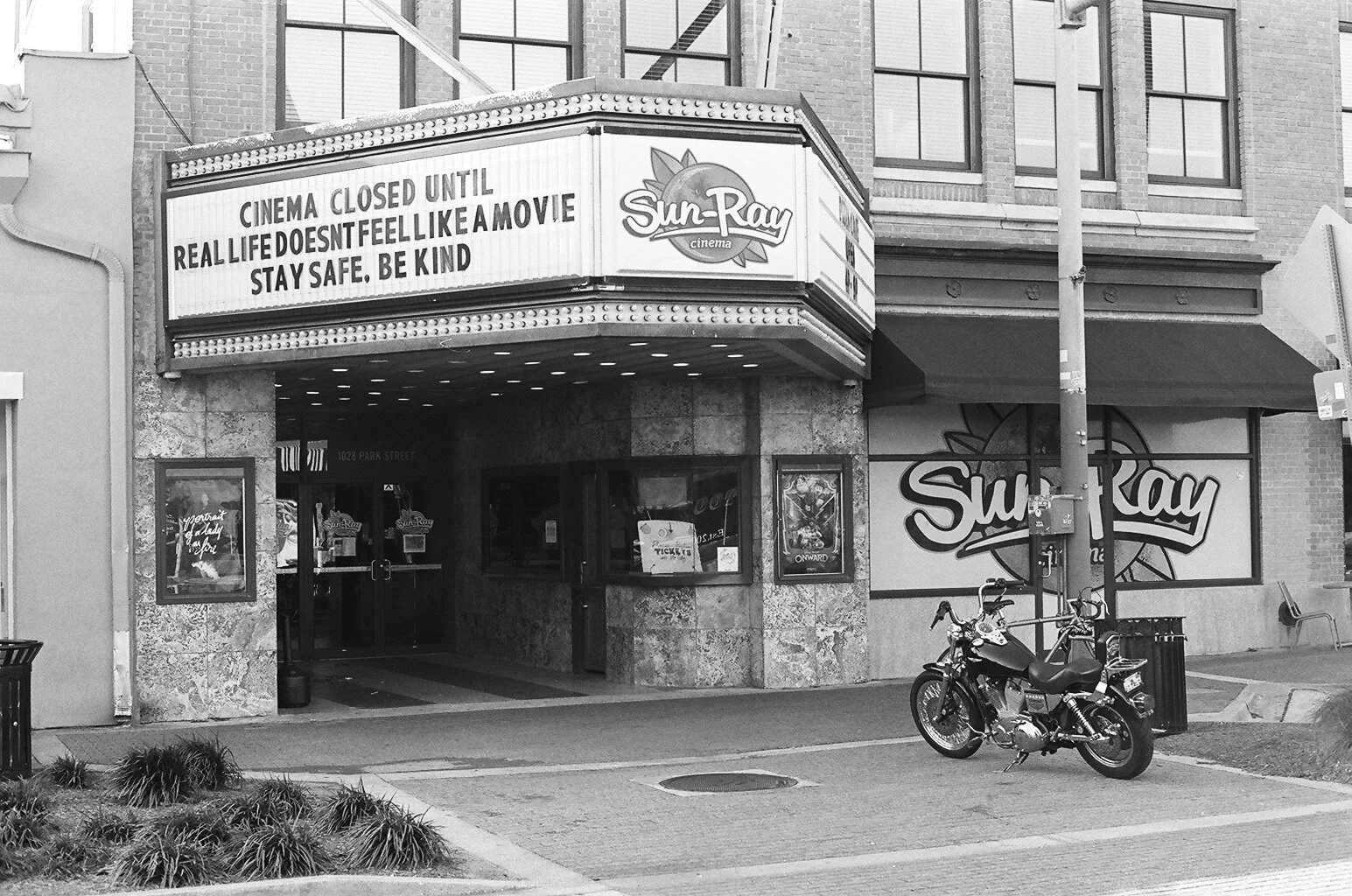
Marquees at neighborhood cinemas announce closures and urge the public to “Stay Safe. Be Kind.” as theaters go dark.
During 2020 and 2021, entertainment venues that once gathered crowds became platforms for moral appeal, reinforcing social restraint and civility. The language reflects a period when uncertainty and isolation required not only compliance, but patience and mutual consideration as public life paused.
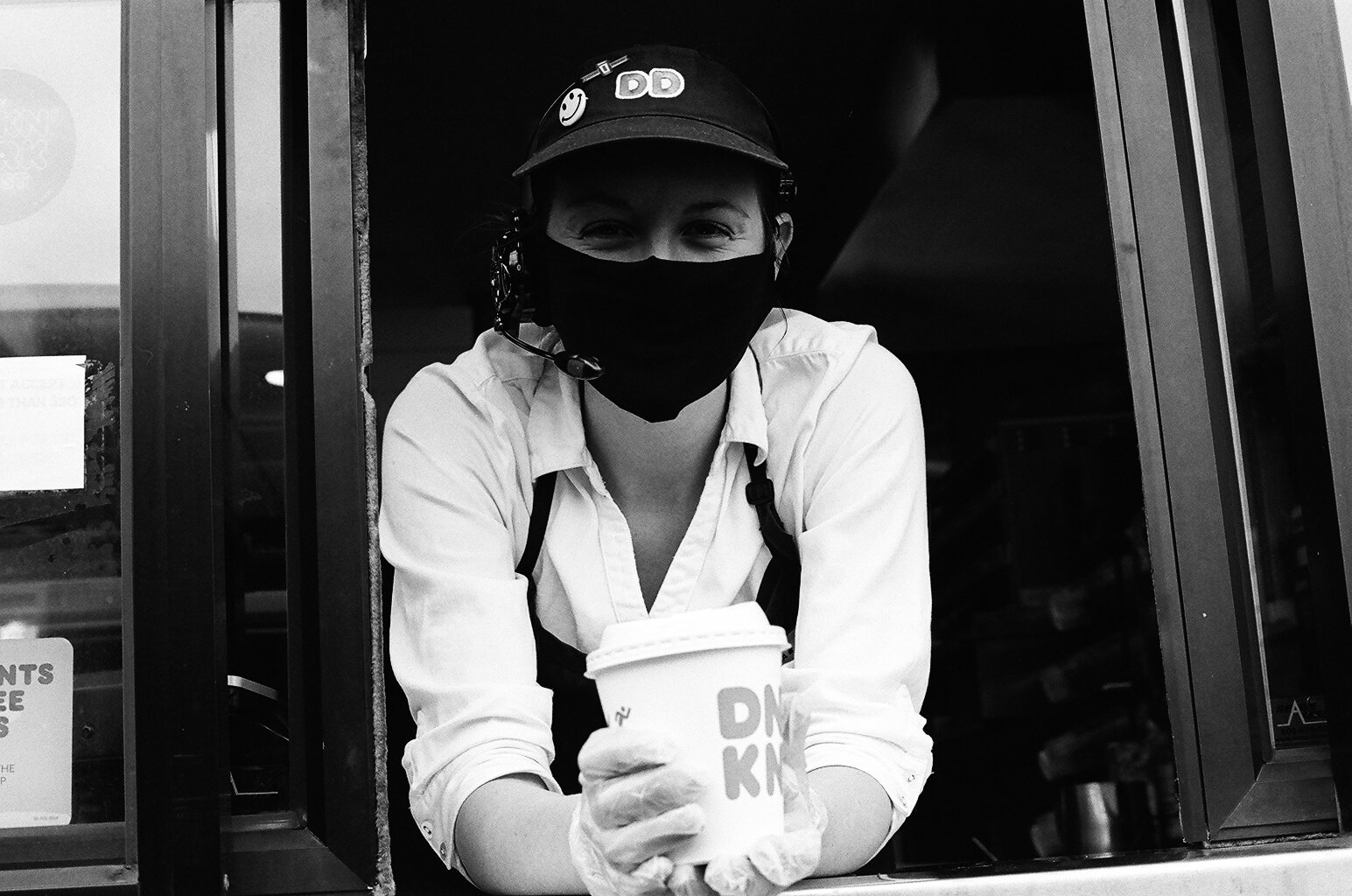
A drive thru worker extends a cup of coffee, her smile visible only in her eyes above a black mask.
Essential workers like her sustained daily life through routine acts of service, revealing that resilience and humanity remained visible even when half the face was concealed and life has migrated fully online.
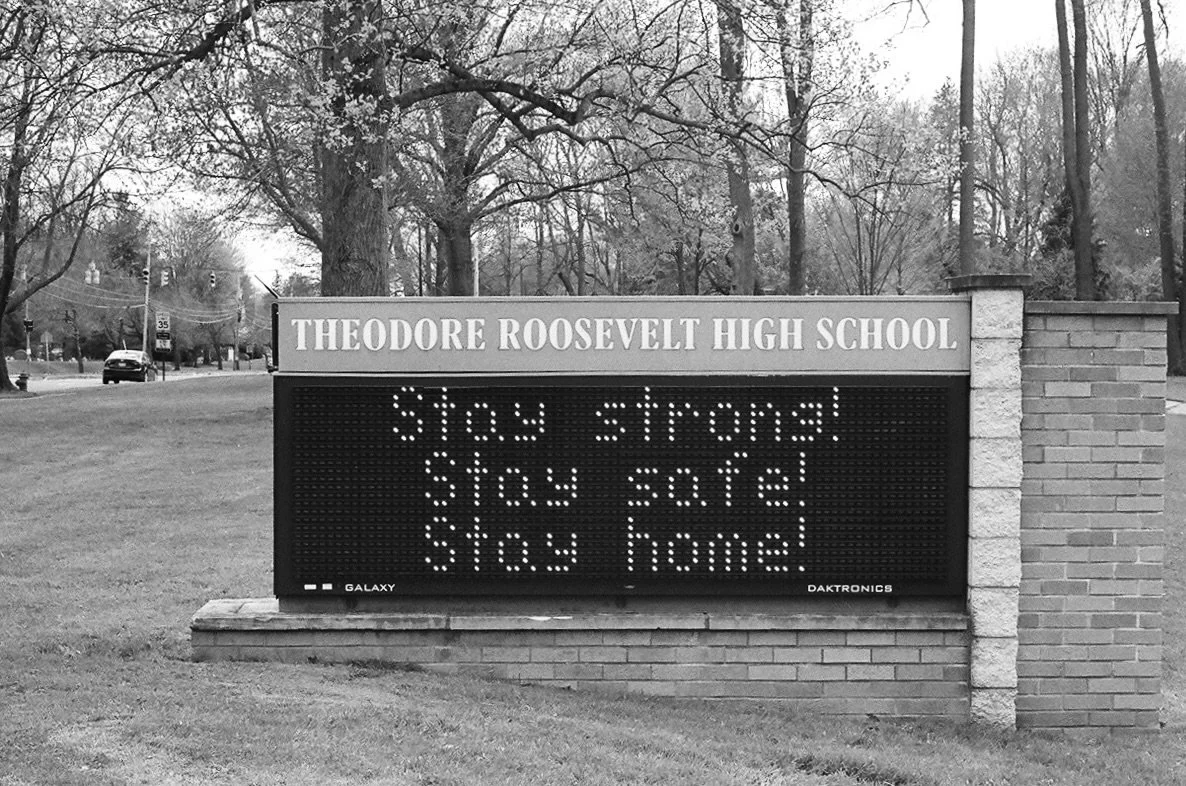
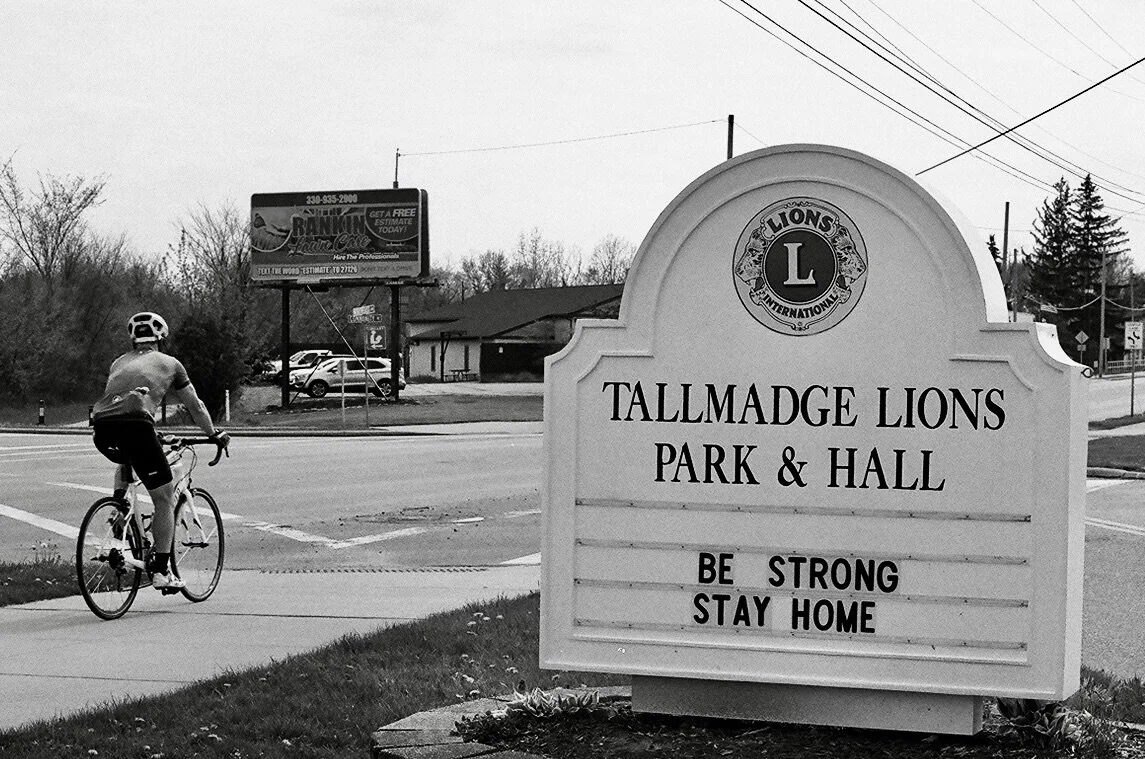
Signs outside a park hall and a high school display a unified directive: Stay Home.
During 2020 and 2021, civic spaces replaced announcements of games and gatherings with instructions for isolation. The repetition of the message across institutions reflects how collective responsibility was framed as withdrawal, and participation in public life was redefined as physical absence.
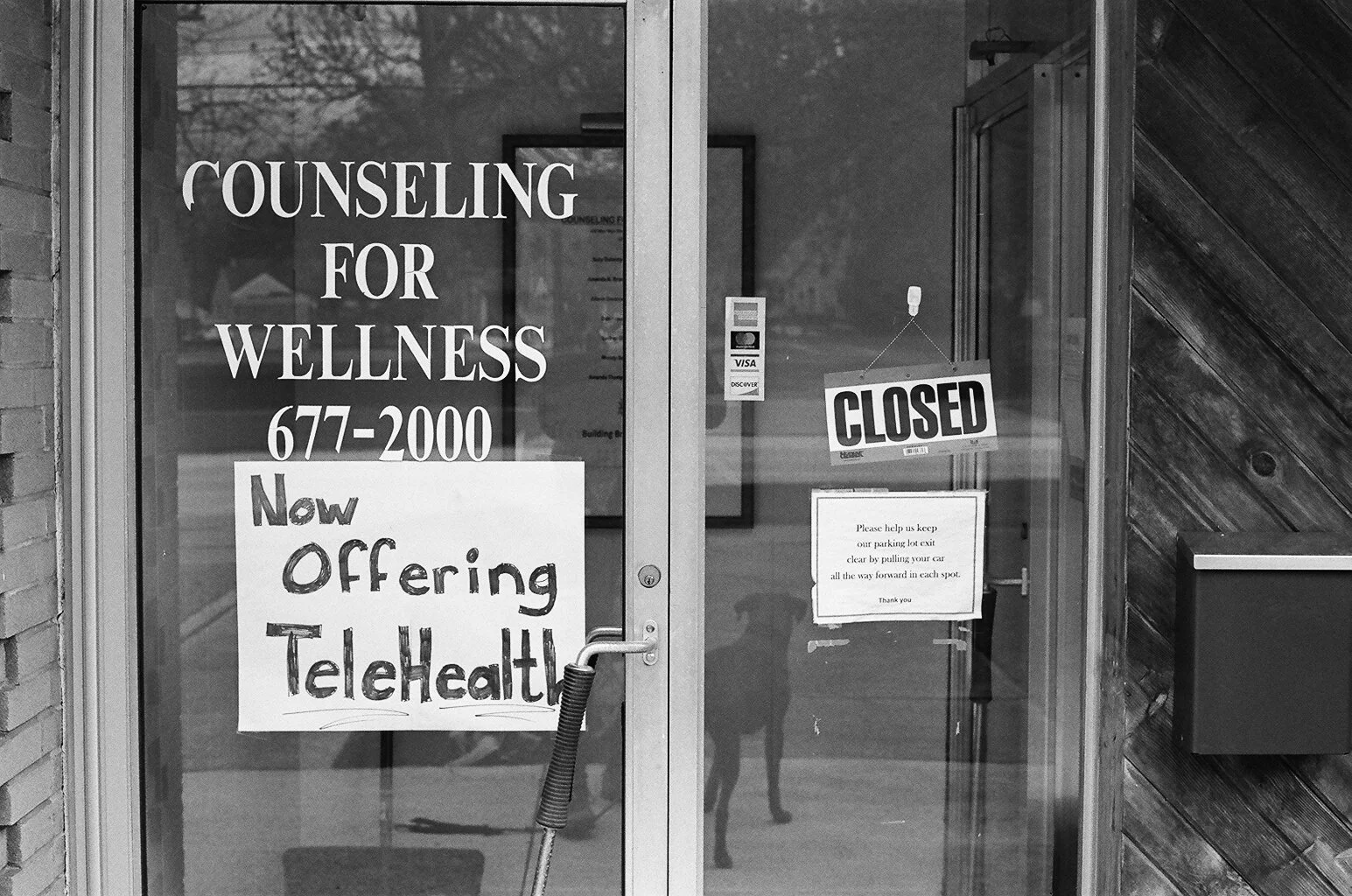
A counseling office door displays a “Closed” sign beside a handwritten notice announcing the shift to telehealth.
During the pandemic of 2020 to 2022, commercial buildings were ordered shut and daily life was pushed almost entirely online. Work, therapy, school, and even family gatherings migrated to screens, marking a rapid and historic transfer of human interaction from physical space to digital infrastructure.
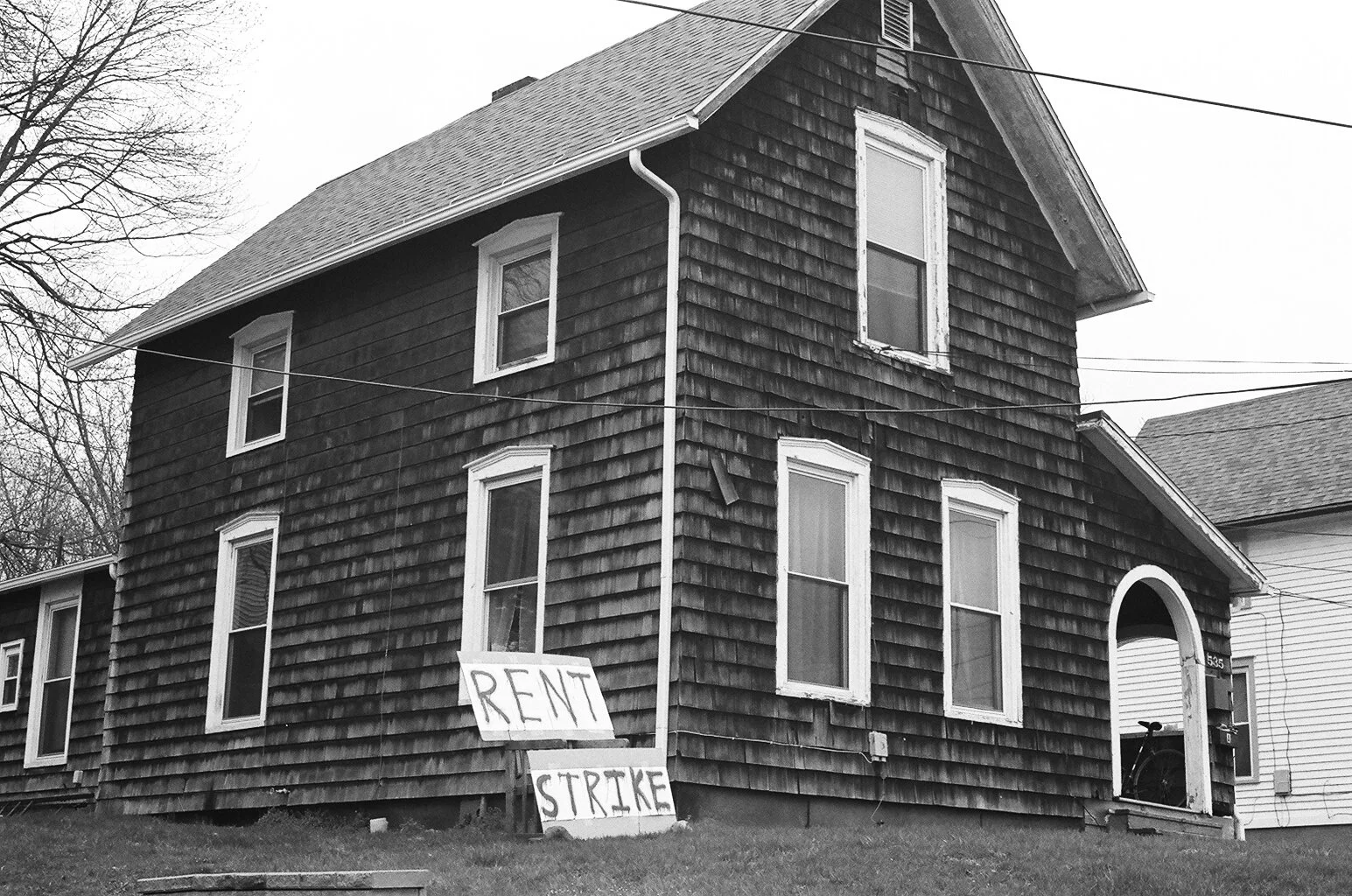
A weathered house stands quiet, a handmade sign reading “Rent Strike” posted in the front yard.
The pandemic reshaped work and income overnight. 30 million Americans applied for unemployment in the first few month. Housing became a fault line between survival and obligation. The sign reflects a moment when private homes turned into political statements, revealing how economic strain and public health crisis collided at the most intimate level of daily life.
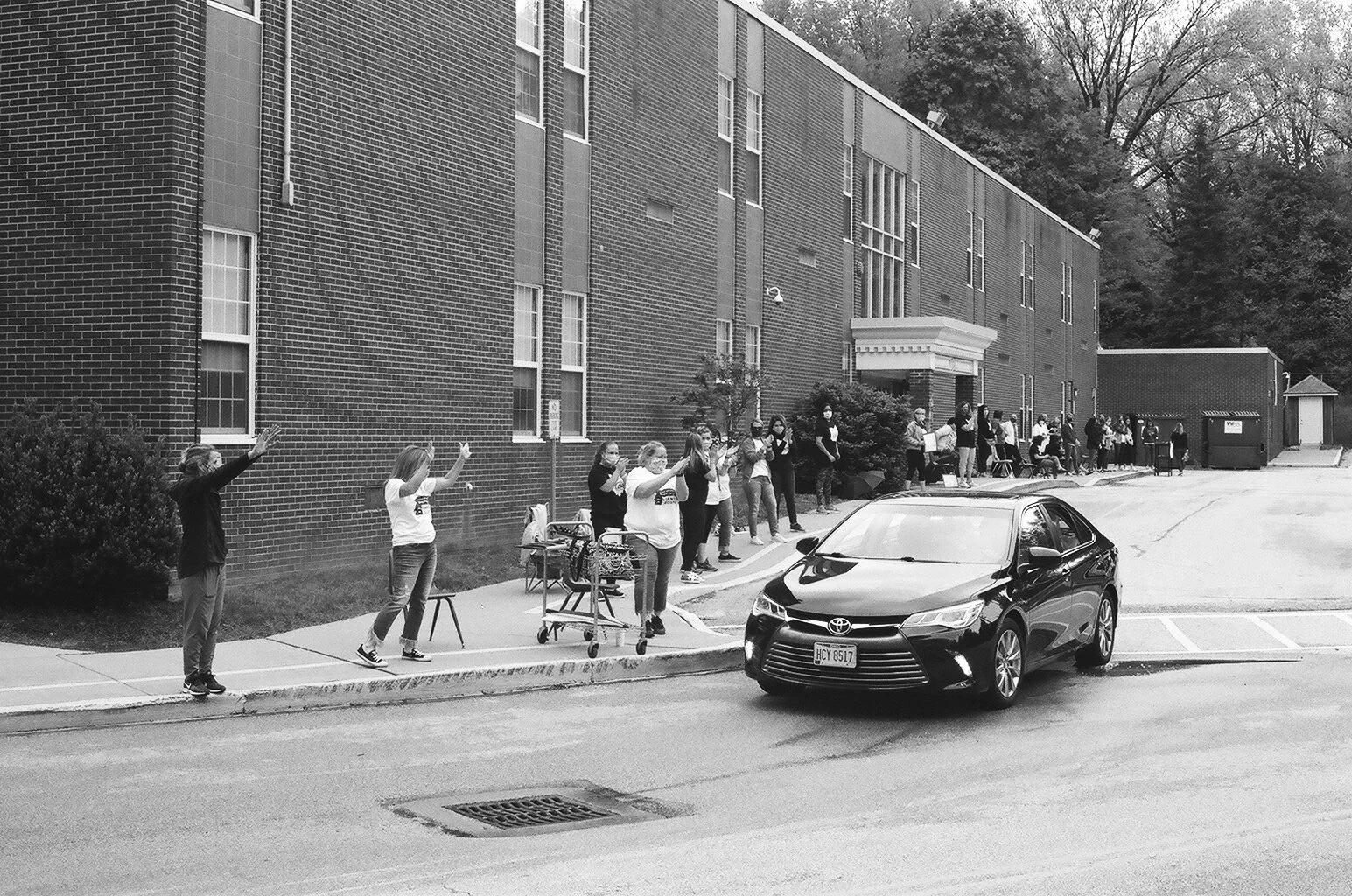
Teachers stand spaced apart and wearing masks outside a school building, waving as graduating students pass by in cars.
With in person classes suspended and proper social distancing enforced during 2020 and 2021, commencement ceremonies were redesigned to eliminate gathering. The drive through graduation reflects a broader shift toward remote learning and structured separation, as institutions adapted rituals to comply with public health mandates.
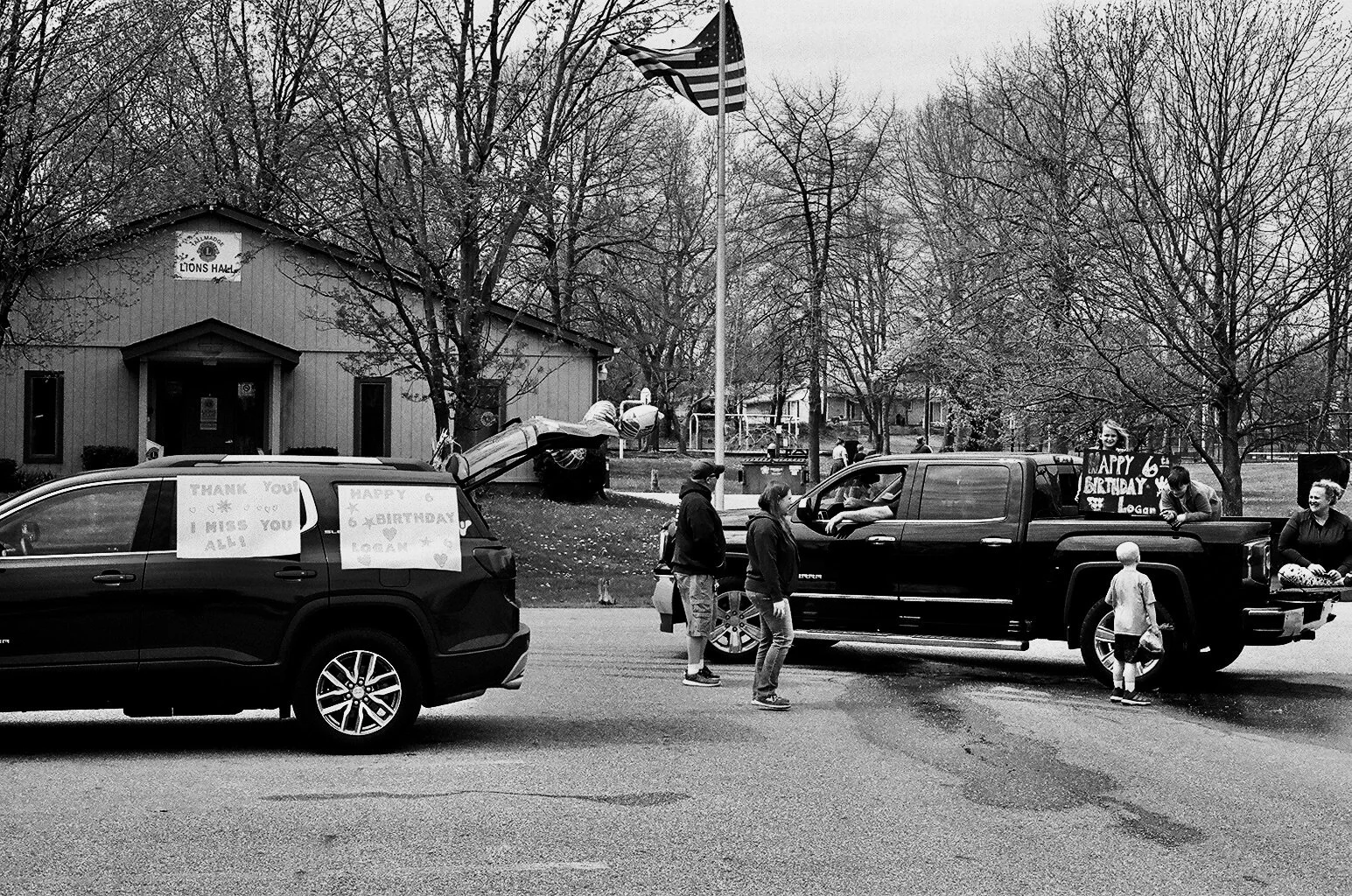
Cars decorated with handmade signs drive past a young boy standing outside on his birthday.
During the pandemic of 2020 and 2021, even childhood milestones were restructured to comply with distancing mandates. The drive by celebration reflects how families adapted intimacy and ritual to a period defined by separation, preserving connection through motion rather than gathering.
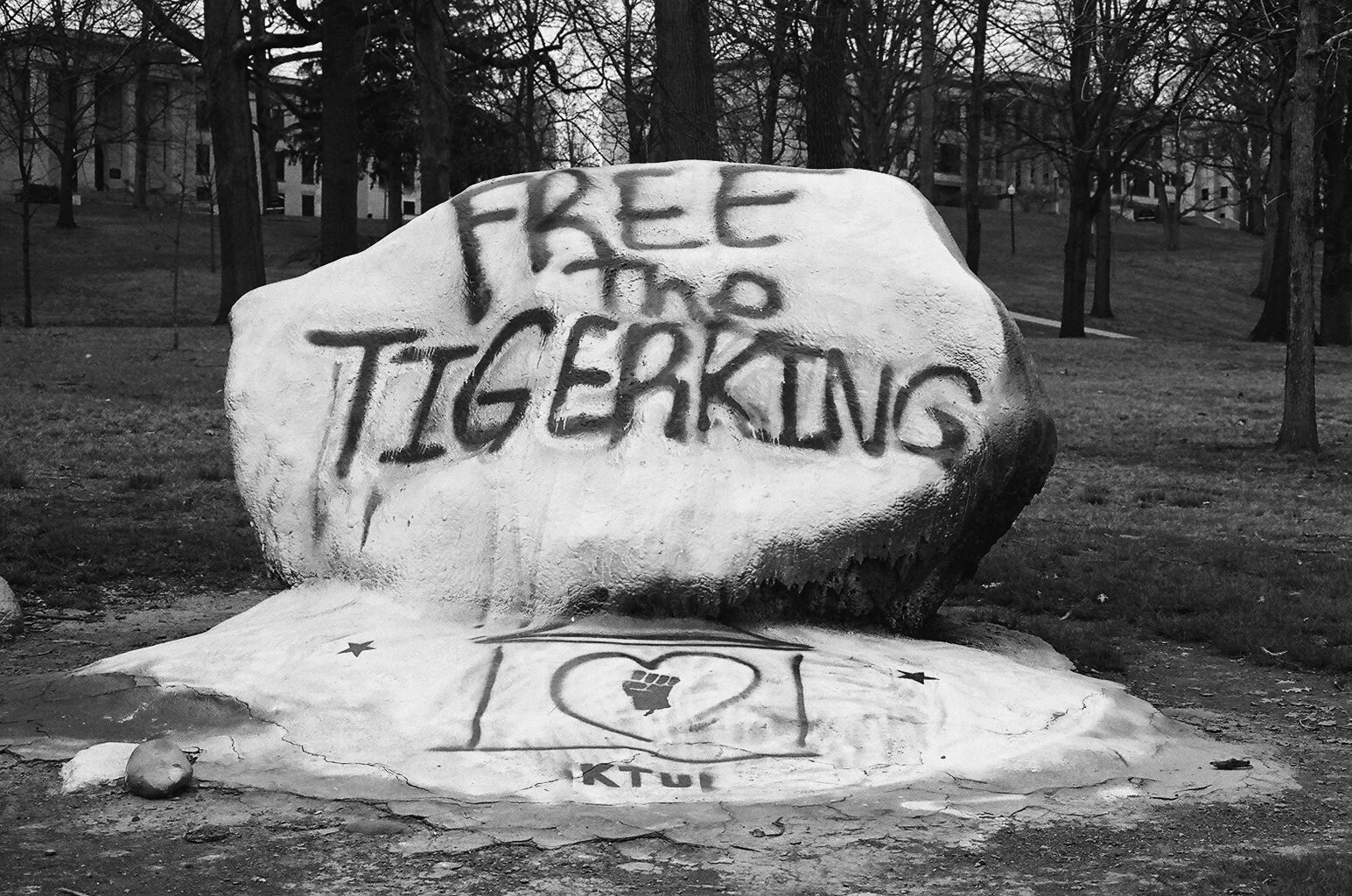
A campus rock is spray painted with the words “Free the Tiger King,” referencing the Netflix series that dominated early lockdown culture.
As physical life narrowed during 2020, attention shifted almost entirely to screens, and Tiger King became a defining viral phenomenon of the pandemic era. The image reflects how isolation, spectacle, and digital fame converged, accelerating a cultural migration toward online identity and entertainment.
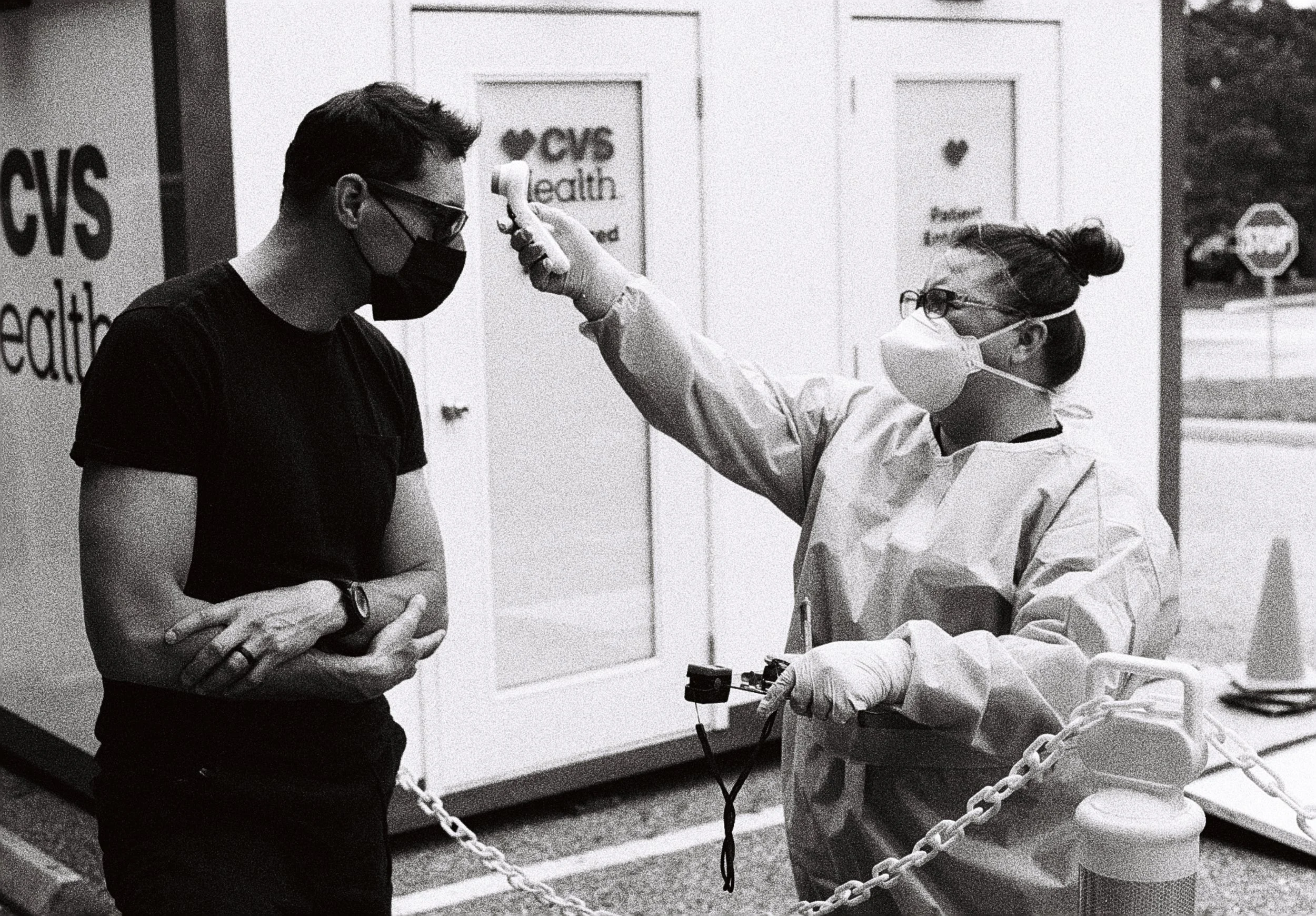
A masked healthcare worker in protective gear checks a man’s temperature outside a CVS Health clinic.
During the pandemic of 2020 and 2021, the term “frontline workers” entered daily vocabulary, describing medical staff, retail employees, and service workers who remained exposed while much of the public sheltered at home. The image reflects how routine medical screening became a visible barrier between public space and contagion, redefining ordinary interactions as matters of collective risk management.
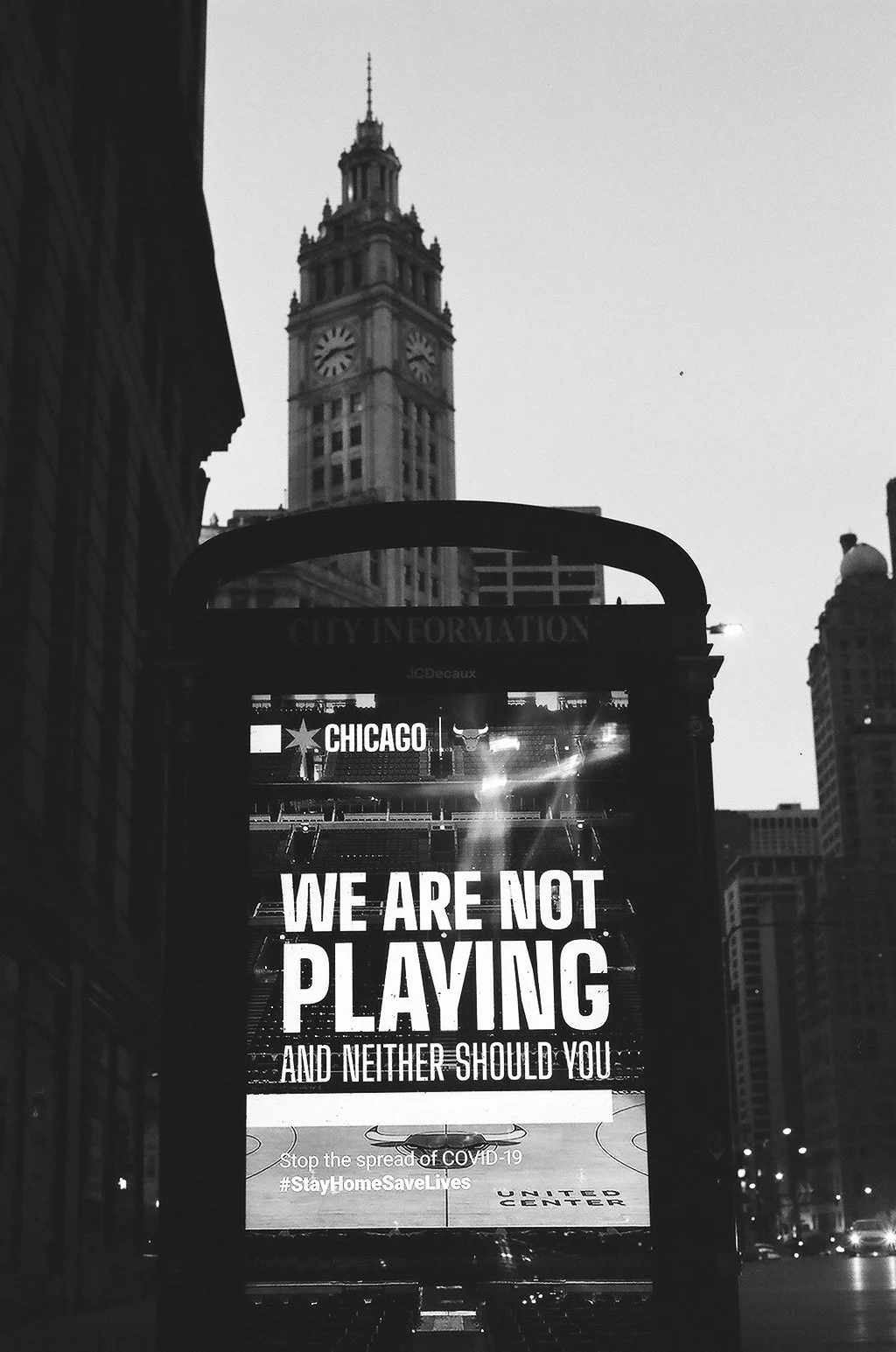
A digital city information board in downtown Chicago displays the message, “We Are Not Playing and Neither Should You,” urging residents to stop the spread of COVID-19.
Public space became a broadcast channel, replacing casual movement with instruction and warning. The illuminated screen stands beneath historic architecture, signaling a moment when authority, urgency, and daily behavior were mediated through digital messaging rather than face to face exchange.